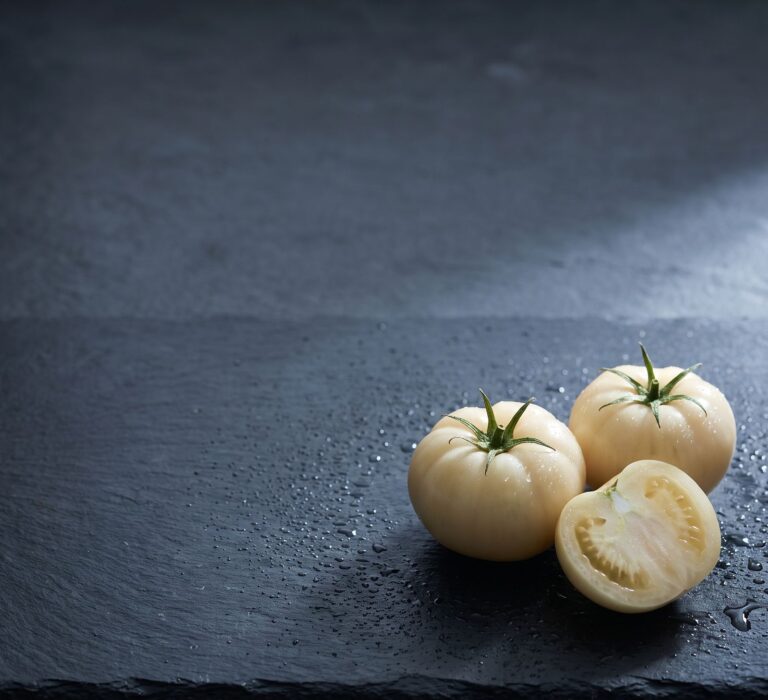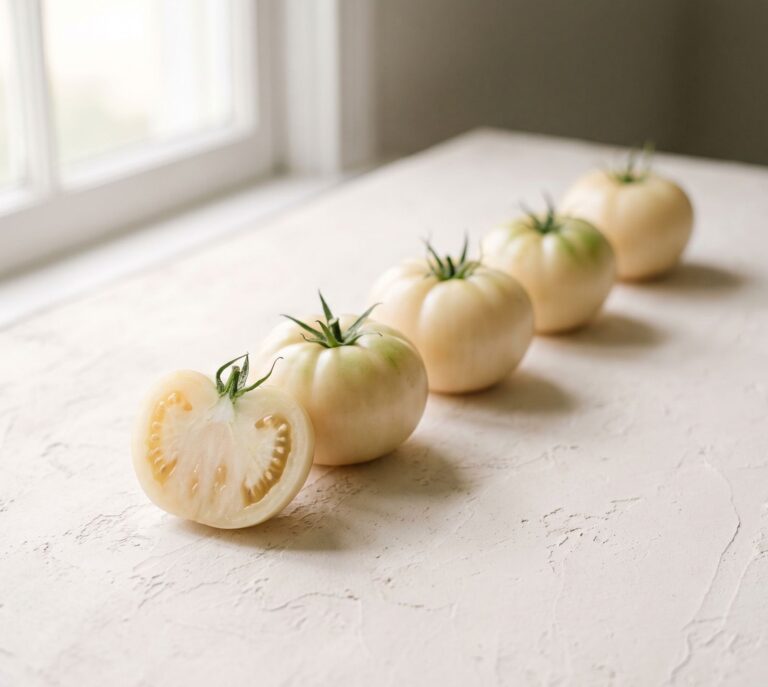
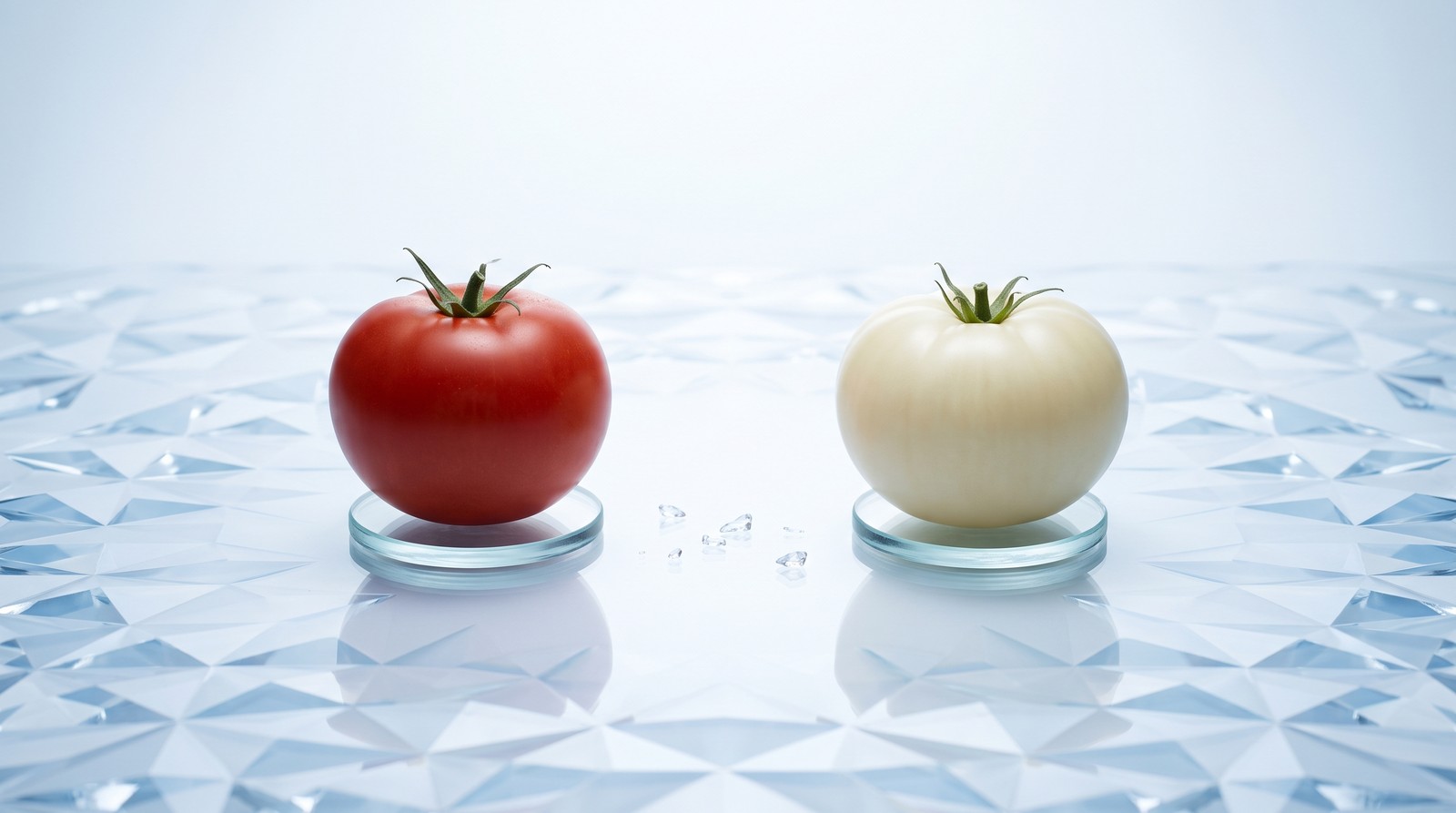
White tomato is a non-GMO heirloom variety that stays pale when fully ripe, because it makes almost no lycopene. What it makes instead is an unusually high load of two colourless carotenoids. This page is the short version, with links to the long ones.
01 — What it is
Two colourless carotenoids
An ordinary tomato is red because of lycopene. A white tomato is pale because it stops earlier in the same pathway, accumulating phytoene and phytofluene instead. Both are carotenoids; neither absorbs visible light, which is exactly why the fruit looks white.
What they do absorb is ultraviolet. Phytoene peaks around 287 nm, in the UVB range associated with burning and redness. Phytofluene peaks around 348 and 366 nm, in the long-wave UVA range associated with ageing and pigmentation. Between them they cover the two UV bands that matter for skin.
The full explanation, with the absorption figures and what the published human research measured, is in White Tomato Science.
02 — Where it wins
What white tomato beats, and why it beats it
It beats lycopene at the job that matters for skin. Lycopene is the red one, and red is the problem: a pigment that absorbs visible light does nothing about the ultraviolet bands that age skin. A white tomato stops earlier in the same pathway and banks phytoene and phytofluene instead — the two carotenoids that absorb UVB and long-wave UVA. Same fruit, better half of the pathway.
It beats glutathione on the part nobody talks about: getting there. Glutathione is a peptide, three amino acids joined together, and your gut digests peptides — which is why the dramatic results people quote come from drips rather than from capsules. Phytoene and phytofluene have the opposite property. They are fat-soluble, they survive the journey when they travel in a lipid carrier, and they accumulate in skin tissue, which is where you wanted them. Ours are wrapped in patented Herbosomal® encapsulation, measured by the manufacturer at up to twice the bioavailability of standard extraction. The full comparison is on White Tomato vs Glutathione.
It does what sunscreen cannot. Sunscreen is a filter sitting on the surface. It sweats off, it gets missed on the ears and the hairline, and it stops working the moment you stop reapplying. White tomato works from the other end — the carotenoids sit inside the skin and raise its own tolerance to UV. In published human studies on colourless carotenoids, the minimal erythema dose, the amount of ultraviolet skin takes before it reddens, rose by roughly 10 to 20 per cent over twelve weeks. Use both. One filters what lands on you; the other changes what your skin does with whatever gets through.
03 — Read further
Everything we have written on white tomato
- White Tomato Science: Phytoene, Phytofluene and Herbosomal Delivery — what the two compounds absorb, what the human research measured, and how much is in a sachet.
- The Laboratory Data, in Full — the finished formula tested at the School of Pharmacy, Lincoln University College: methods, tables, and an honest account of what the results do and do not show.
- White Tomato vs Glutathione — mechanism, delivery and daily effort, side by side.
- Suplemen White Tomato untuk Kulit Cerah — the Malay-language guide, with the full per-sachet dose, price, where to buy, and how to verify the halal certificate yourself.
- How Much White Tomato Actually Reaches Your Skin? — why the fruit does little, what a standardised extract changes, and the four questions that settle any brand.
- White Tomato Supplement Malaysia — who sells what on Malaysian shelves, the four checks that separate a serious product from a vague one, and where to buy.
- White Tomato Supplements in Singapore — what each brand publishes about form, dose, delivery and certification, side by side.
- Lipo Crystal — our own white tomato sachet, with the ingredient table and current price.
04 — Common questions
What people ask about white tomato
White tomatoes are a non-GMO heirloom variety that stays pale even when fully ripe, because the fruit produces almost no lycopene — the pigment that makes an ordinary tomato red. Instead it accumulates two colourless carotenoids, phytoene and phytofluene. They are a real cultivated variety, not an unripe or bleached tomato.
Yes, and there are numbers attached to it. Its two colourless carotenoids absorb ultraviolet rather than visible light, and in published human studies on colourless carotenoids the minimal erythema dose, the amount of UV skin takes before it reddens, rose by roughly 10 to 20 per cent over twelve weeks. On brightness, laboratory testing of the Lipo Crystal formula at the School of Pharmacy, Lincoln University College measured 93.82 per cent inhibition of tyrosinase at 10 mg/ml. Tyrosinase is the enzyme that starts melanin production, so a brighter and more even tone comes from making less new pigment. Give it twelve weeks. Carotenoids build up in skin over months, not days.
Not in any useful amount. Phytoene and phytofluene are locked inside the fruit cell walls in quantities that vary from tomato to tomato, and carotenoids are fat-soluble, so raw fruit gives up very little of them. That is exactly why a standardised extract exists, and why it is wrapped in patented Herbosomal encapsulation before it goes into the sachet: the manufacturer measures up to twice the bioavailability of standard extraction. One Lipo Crystal sachet delivers 500 mg of standardised white tomato extract, every day, in a form built to survive digestion. A salad does not.
Ask any brand what it will show you, then look at what Lipo Crystal shows. The amounts are printed on the carton, not hidden inside a proprietary blend: 500 mg of Herbosomal white tomato extract and 600 mg of liposomal vitamin C in every 3 g sachet. It is a standardised extract in a patented delivery system, not dried fruit powder. It has been laboratory tested at the School of Pharmacy, Lincoln University College, an institution we name. And it is made in a facility that is US FDA-registered and certified GMP, MeSTI and HACCP, with JAKIM Halal certification held since 2014.
Where the dose is printed
Lipo Crystal declares 500 mg of Herbosomal® white tomato extract and 600 mg of liposomal vitamin C in every 3 g sachet — on the carton, not inside a proprietary blend. One box is RM139 for 20 sachets, RM6.95 a day.
Every ingredient, with its amount: the full Lipo Crystal label — ten declared actives, each placed next to the dose used in the published human trials, including the three that sit below it — is set out on the ingredients page.