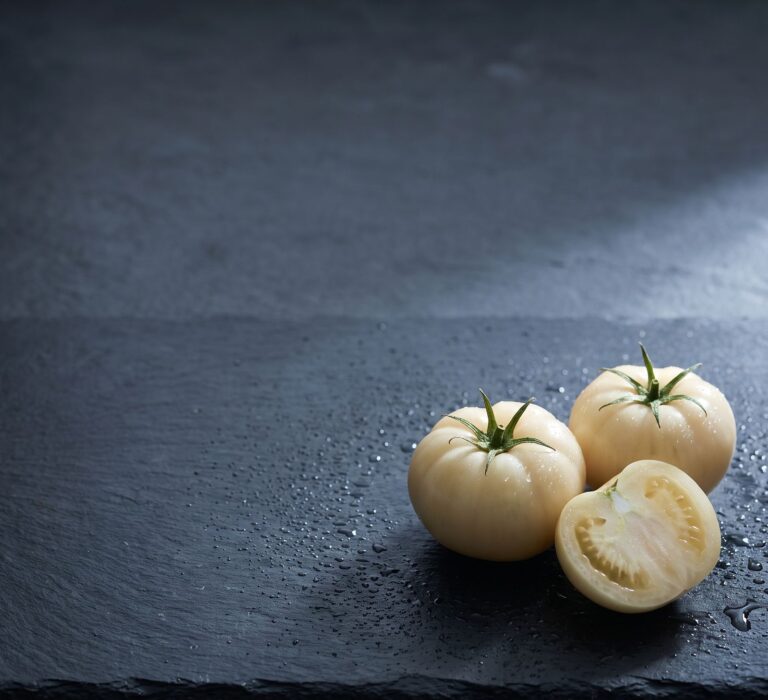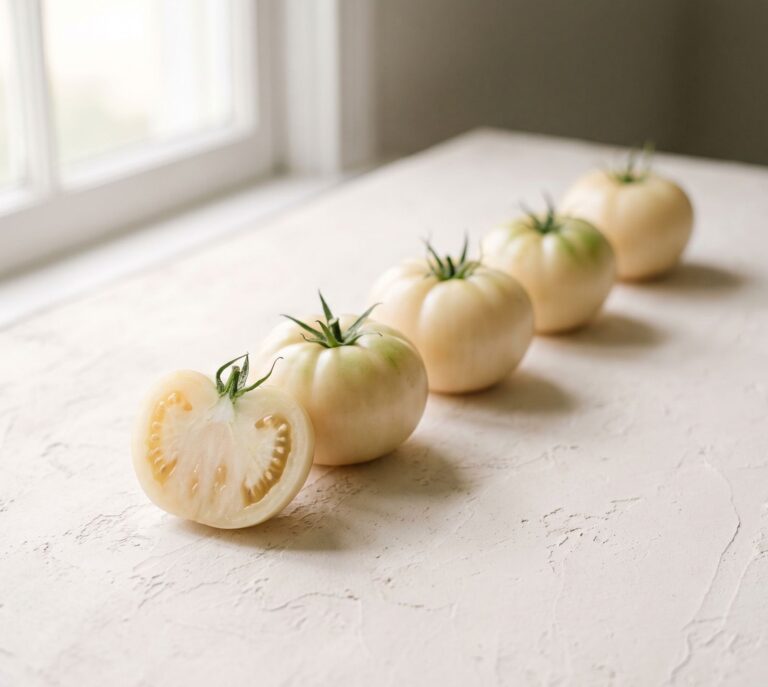
White tomato is not a marketing name for a pale tomato. It is a non-GMO heirloom variety that carries almost no coloured carotenoids — and an unusually high load of two colourless ones. This page sets out what the published research on those compounds actually shows, and where Lipo Crystal’s own measurements sit alongside it.
01 — The ingredient
Bahasa Melayu: Suplemen White Tomato untuk Kulit Cerah — panduan lengkap, harga dan status halal JAKIM.
Start here: What white tomato is, in two minutes — the short version, with links to everything else we have written on it.
Also worth reading: How much white tomato actually reaches your skin? — on dose, standardised extract versus fruit powder, and why delivery decides whether the number on the pack counts.
What makes white tomato different
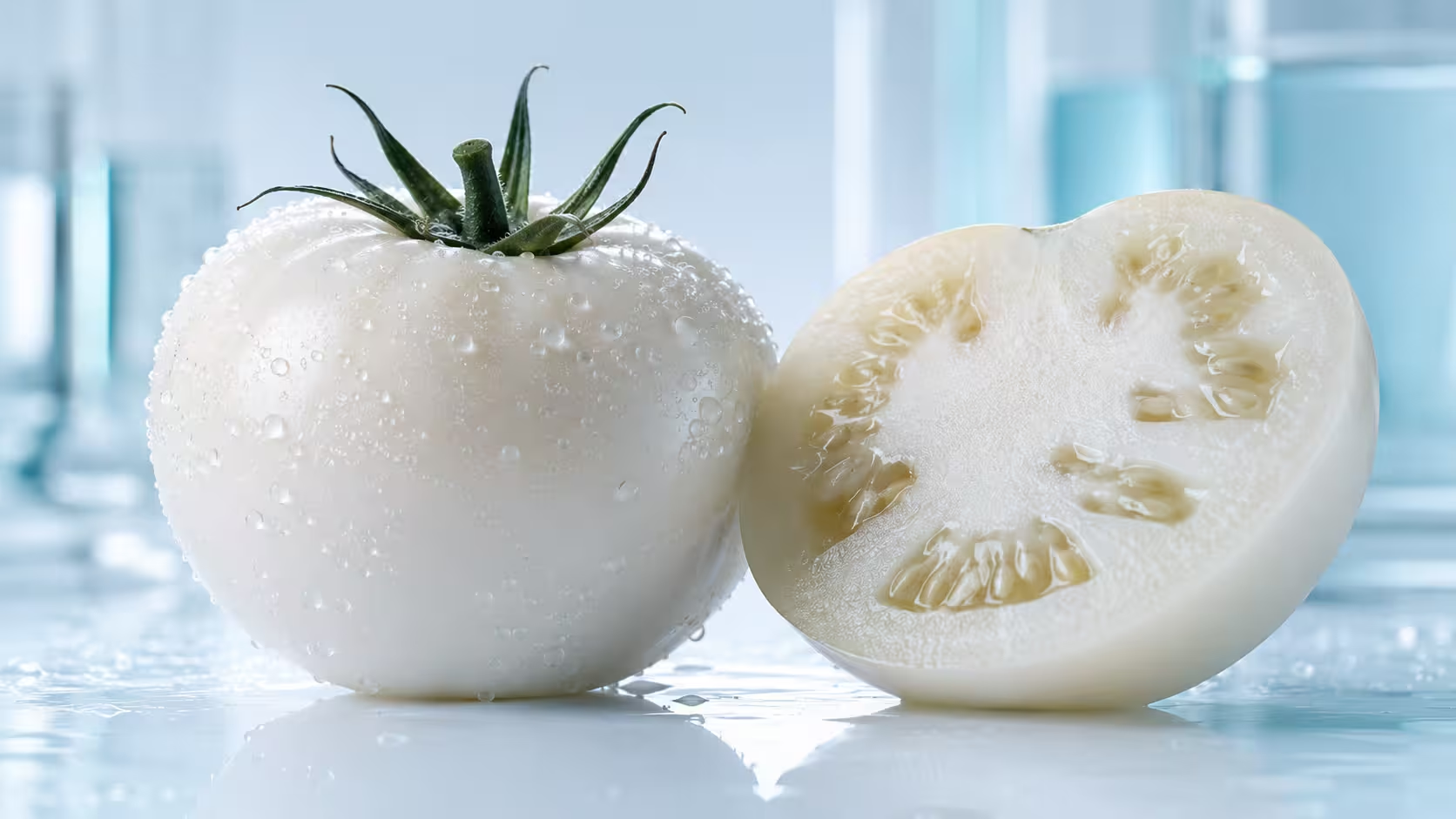
An ordinary tomato is red because of lycopene. A white tomato has almost none — instead it is one of nature’s richest sources of the two colourless carotenoids, phytoene and phytofluene.
Colourless is the whole point. These molecules absorb nothing in the visible spectrum, which is why the fruit looks white. What they do absorb is ultraviolet:
| Compound | Peak absorption | UV range it covers |
|---|---|---|
| Phytoene | λmax 287 nm | UVB — the band associated with sunburn and redness |
| Phytofluene | λmax 348 & 366 nm | UVA — the long-wave band associated with photo-ageing and pigmentation |
Absorption maxima as reported in the carotenoid literature. Between them the two compounds span both UV bands relevant to skin.
02 — Published human research
What the studies on colourless carotenoids found
This section is about the ingredient, not about Lipo Crystal. The work below was carried out by independent researchers on colourless-carotenoid supplementation in general, and is published in the journals cited beneath the table.
| Study design | What was measured | Result |
|---|---|---|
| Healthy volunteers taking an oral carotenoid complex daily for 12 weeks | Minimal erythemal dose (MED) — how much UV the skin tolerates before it reddens | +10% to +20% on average |
| Same cohort, self-reported and instrument measures | Suppleness, roughness, evenness of tone | Improvement reported by 55–95% of volunteers, depending on the measure |
Sources: MDPI Nutrients — Skin Carotenoids in Public Health and Nutricosmetics; PubMed — Supplementation with Tomato-Based Products Protects Against UV-Light-Induced Erythema.
What a rise in MED does and does not mean
A higher MED means the skin took more UV before reddening. That is a measure of tolerance, not of pigment. It is a real, instrument-based finding — and it is not a claim about how quickly any particular dark spot fades.
It is also not a substitute for sunscreen. Oral carotenoids raise the skin’s baseline resilience; a topical SPF blocks UV at the surface. The research treats them as complementary, and so do we.
03 — The delivery problem
Why most oral brightening supplements underperform
The compounds are only useful if they arrive intact. Conventional powders and capsules face stomach acid and the liver’s first-pass effect before anything reaches circulation, and the resulting bioavailability is low. That is the most common reason people report seeing “no results” from a brightening supplement — a complaint we take seriously enough to have built the format around it.
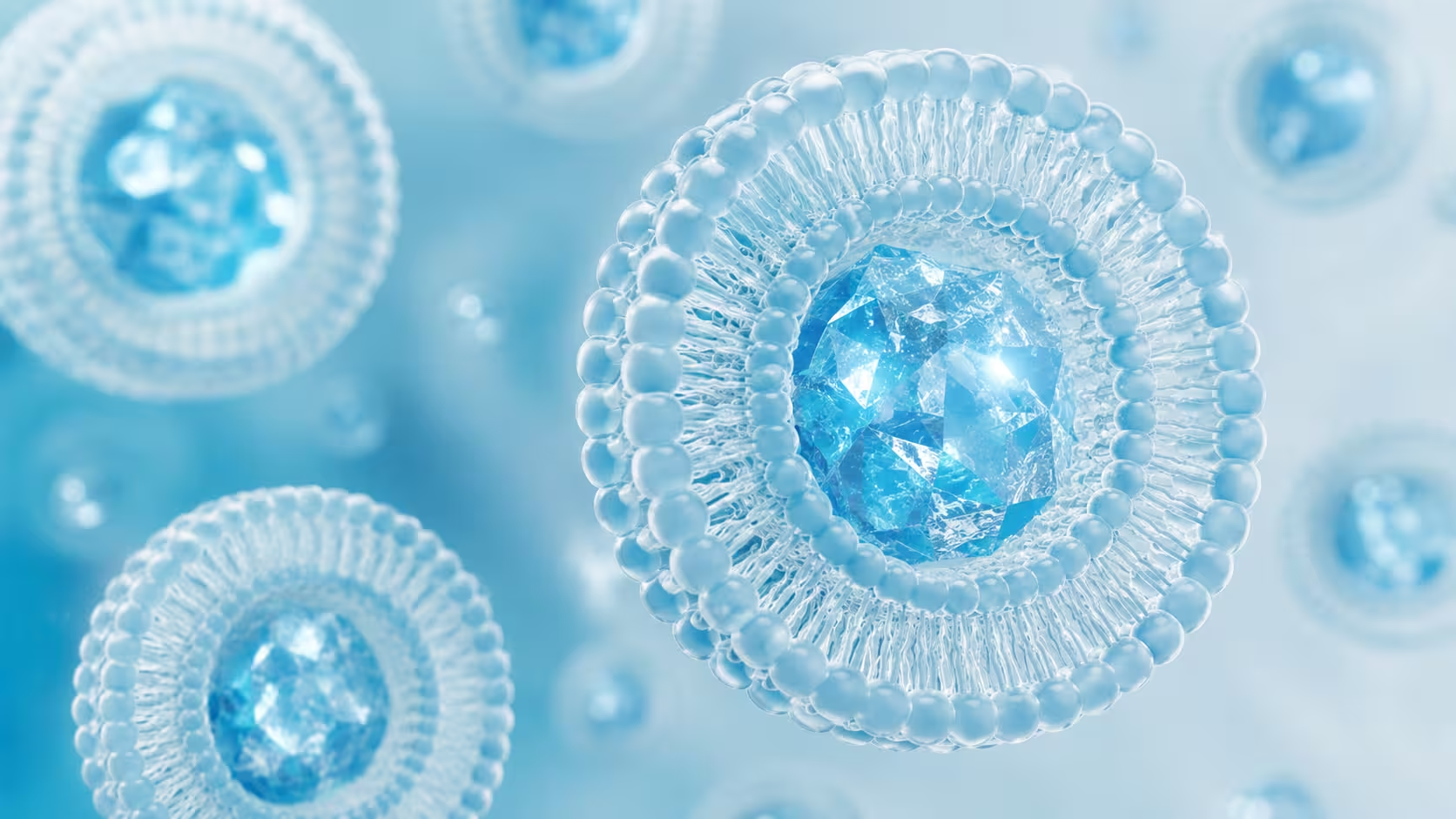
Herbosomal and liposomal encapsulation wraps the active material in a double-layered phospholipid sphere that mirrors the structure of a cell membrane, an approach described in the NIH PMC literature on tomato precursors. The intended effect is threefold:
- PassageThe carrier resembles a membrane rather than food, so more of the payload gets past digestion intact.
- Steadier releaseNutrients are released gradually rather than in a single spike.
- Less wasteMore of each dose reaches circulation, so less of it is spent surviving the journey.
04 — The formulation
What is in each Lipo Crystal sachet
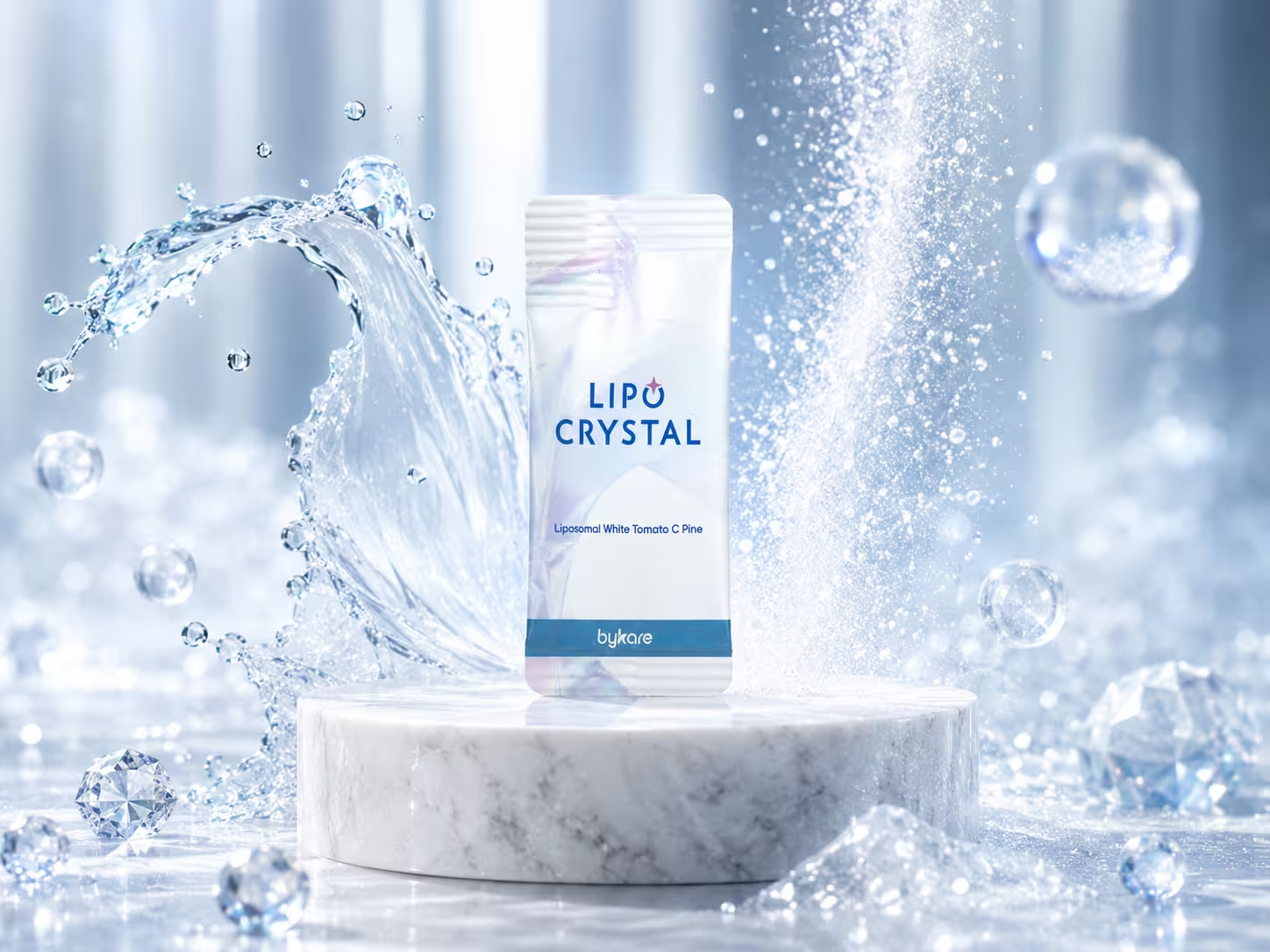
Bykare Lipo Crystal pairs Herbosomal® white tomato extract with three further actives. The doses are printed here in full rather than described as a proprietary blend.
| Active | Per 3 g sachet | Role in the formula |
|---|---|---|
| Pineapple extract (bromelain-rich) | 1250 mg | Bromelain is studied for anti-inflammatory activity; included to support skin texture and post-inflammatory marks |
| Liposomal vitamin C | 600 mg | Antioxidant, and a cofactor in the body’s own collagen synthesis |
| Herbosomal® white tomato extract | 500 mg | The phytoene and phytofluene source described in sections 01 and 02 |
| Tocotrienol (vitamin E) | 20 mg | A form of vitamin E with substantially higher antioxidant capacity than standard tocopherol |
The sachet also contains vitamin D3, zinc and yeast beta glucan. No added sugar, no synthetic fillers, non-GMO. Certified GMP, JAKIM HALAL, MeSTI and HACCP.
05 — Our own testing
What we measured on this formulation
Everything above describes the ingredient. This is the part that describes our product, and the two should not be confused.
The Lipo Crystal formulation was submitted to the School of Pharmacy, Lincoln University College, for independent laboratory analysis. Those are in-vitro enzyme assays — the formulation tested against isolated enzymes on a bench, not a trial in people. They establish that the formulation is biochemically active; they do not predict an outcome for any individual.
The headline figures, with their conditions attached
Tyrosinase inhibition 93.82% and hyaluronidase inhibition 89.95%, both at 10 mg/ml. Free-radical scavenging DPPH IC50 46.52 µg/ml. Measured vesicle size 392.7 nm.
The methods, the full dose-response tables and an honest statement of the limits are published in the laboratory data page, along with the downloadable report.
06 — Questions
Common questions about white tomato
No. It is a distinct non-GMO heirloom variety that stays pale at full ripeness because it produces almost no lycopene. What it produces instead is a high concentration of the colourless carotenoids phytoene and phytofluene.
They are carotenoids that absorb ultraviolet rather than visible light, which is why they appear colourless. Phytoene peaks at 287 nm in the UVB range and phytofluene at 348 and 366 nm in the UVA range, so between them they cover both UV bands relevant to skin.
No, and it should not be used that way. Published research shows oral colourless carotenoids raise the minimal erythemal dose — the skin’s tolerance before it reddens — by roughly 10 to 20% over 12 weeks. That is a change in baseline resilience, not a barrier at the skin surface. Keep using topical SPF.
The published human work ran for 12 weeks, and skin turnover is slow by nature. Assess over 60 days of consistent daily use rather than over a week, and expect gradual change rather than a visible before-and-after.
500 mg of Herbosomal® white tomato extract per 3 g sachet, alongside 1250 mg bromelain-rich pineapple extract, 600 mg liposomal vitamin C and 20 mg tocotrienol, plus vitamin D3, zinc and yeast beta glucan.
It is consumed as a food supplement, and the formulation is certified GMP, JAKIM HALAL, MeSTI and HACCP. Anyone allergic to pineapple, tomato or yeast-derived ingredients should check the label first, and anyone pregnant, breastfeeding or on medication should speak to their doctor before starting any supplement.
Every ingredient, with its amount: the full Lipo Crystal label — ten declared actives, each placed next to the dose used in the published human trials, including the three that sit below it — is set out on the ingredients page.