Tested, not claimed. The Lipo Crystal formulation was submitted to the School of Pharmacy, Lincoln University College, for independent laboratory analysis. This page publishes what they measured — the methods, the figures, and an honest statement of what the results do and do not show.
01 — Provenance
Who ran the tests, and on what
Evidence is only as good as its traceability. Everything below can be checked against the source report, which is linked at the bottom of this page.
- Testing institutionSchool of Pharmacy, Lincoln University College — Wisma Lincoln, SS 6/12, 47301 Selangor, Malaysia
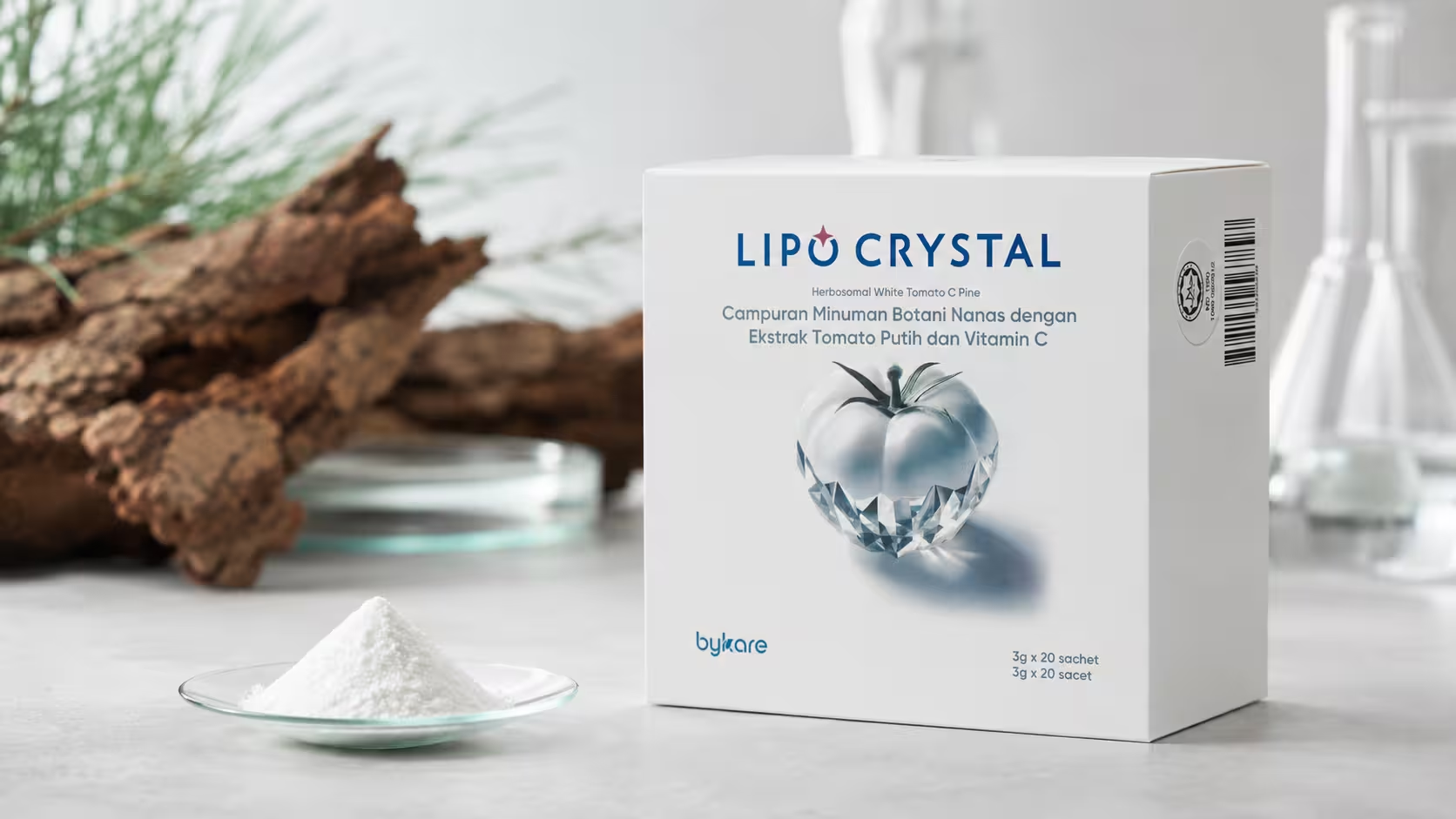
- Sample testedLipoCrystal formulation, manufactured by Bionutricia Manufacturing Sdn Bhd, Malaysia
- Particle characterisationDynamic Light Scattering (DLS) — particle size and zeta potential
- Collagenase inhibitionSpectrophotometric assay using FALGPA substrate (Van & Steinbrink 1981, modified)
- Xanthine oxidase inhibitionSpectrophotometric assay at 290 nm, xanthine as substrate
- Antioxidant & additional assaysDPPH radical scavenging, FRAP, nitric oxide inhibition, tyrosinase, hyaluronidase
Why we publish the methods, not just the headline number
A percentage in an advertisement means nothing without the concentration it was measured at, the substrate used, and who did the measuring. Every figure on this page carries all three.
02 — The formulation
What is in the sachet, and how it is delivered
Lipo Crystal uses liposomal and herbosomal encapsulation — nutrients wrapped in a phospholipid layer that mirrors the structure of a human cell membrane. The intention is that the nutrient survives the stomach and is carried into circulation rather than broken down on the way. That absorption problem is the most common criticism of oral brightening supplements, and it is covered in more depth in our explainer on white tomato and herbosomal delivery.
| Parameter | Measured value | Method |
|---|---|---|
| Particle size | 392.7 nm | Dynamic Light Scattering |
| Zeta potential | −1.4 mV | Dynamic Light Scattering |
Values as reported by the testing laboratory. Particle size describes the measured vesicle diameter of the encapsulated system; zeta potential describes the surface charge of those vesicles.
Why a dry powder, and not a liquid
Most liposomal supplements are sold as liquids. A liposome suspended in water is chemically busy from the day it is filled — vesicles can fuse, settle or oxidise over the weeks a bottle sits on a shelf or in a warm room, which is why liquid formats usually carry refrigeration advice and short open-bottle windows.
Lipo Crystal is a dry 3 g powder sachet. The encapsulated material stays dry and single-dosed until the moment it meets water, and each sachet is sealed independently, so the last one in the box is in the same state as the first. It also travels through a Malaysian, Philippine or Singaporean climate without a cold chain — a practical difference rather than a laboratory one, but the reason the format was chosen.
03 — Results
What the assays measured
All results are dose-dependent — inhibition rises as concentration rises, which is what a genuine biochemical effect looks like as opposed to background noise.
Skin-related enzyme activity
| Concentration | Anti-tyrosinase | Hyaluronidase inhibition | Anti-inflammatory |
|---|---|---|---|
| 1 mg/ml | 68% | 60% | 64% |
| 2 mg/ml | 78% | 72% | 75% |
| 5 mg/ml | 88% | 84% | 86% |
| 10 mg/ml | 93.82% | 89.95% | 91.6% |
Collagenase inhibition
| Concentration | Inhibition (mean ± SD) | IC50 |
|---|---|---|
| 10 µg/ml | 56.12 ± 1.9% | 127.6 µg/ml 95% CI 102.9 – 158.4 |
| 50 µg/ml | 59.40 ± 0.8% | |
| 100 µg/ml | 61.63 ± 1.1% | |
| 250 µg/ml | 65.96 ± 1.4% | |
| 500 µg/ml | 70.45 ± 0.6% |
Xanthine oxidase inhibition
| Concentration | Inhibition (mean ± SD) | IC50 |
|---|---|---|
| 10 µg/ml | 47.03 ± 1.4% | 62.29 µg/ml 95% CI 52.40 – 74.05 |
| 50 µg/ml | 59.00 ± 4.0% | |
| 100 µg/ml | 68.19 ± 2.2% | |
| 250 µg/ml | 72.35 ± 0.7% | |
| 500 µg/ml | 76.47 ± 0.5% |
Xanthine oxidase is an enzyme involved in the body’s production of uric acid. It was part of the laboratory’s assay panel. Lipo Crystal is a skin and wellness supplement and is not offered for any use related to uric acid.
Antioxidant activity
| Assay | Result | What it measures |
|---|---|---|
| DPPH radical scavenging | IC50 46.52 µg/ml | The concentration at which the formulation neutralised half the free radicals in the test system |
A lower IC50 indicates a stronger effect — less material is needed to reach the same result.
04 — In plain language
What each enzyme actually does
Each card states what the enzyme does in the body, and what the laboratory result does not tell us.
Tyrosinase
Tyrosinase is the enzyme that starts melanin production. It is the target most skin-brightening research aims at.
Measured in a laboratory assay, not on skin. It does not predict how much any individual’s tone will change.
Hyaluronidase
Hyaluronidase breaks down hyaluronic acid — the molecule that holds moisture and volume in skin.
Enzyme-level activity in a test system. Not a measure of skin hydration in a person.
Collagenase
Collagenase degrades collagen in the skin’s supporting matrix — part of why skin loses firmness over time.
An in-vitro inhibition figure. It is not a claim about wrinkles or firmness.
Free radicals (DPPH)
Free radicals accumulate from UV exposure and daily oxidative stress. DPPH is a standard bench test of scavenging capacity.
A chemical measurement of antioxidant capacity, not of any outcome in the body.
05 — The limits
What this data is — and what it is not
Read this before you read anything else on this page
This is in-vitro laboratory data. The assays were performed on the formulation in a controlled test system, measuring how it behaves against isolated enzymes and free radicals. That is a real, standard and repeatable way to establish that a formulation is biochemically active.
It is not a clinical trial. No human participants were involved and no outcome in skin was measured. Laboratory activity indicates potential; it does not guarantee a result for any individual person.
Lipo Crystal is a food supplement, not a medicine. It is not intended to diagnose, treat, cure or prevent any disease. Results vary between individuals and are influenced by sun exposure, sleep, diet and consistency of use.
We publish the limits alongside the numbers because a figure without its context is marketing, not evidence — and because you can check every one of these figures against the source report yourself.
06 — Questions
Questions about the testing
The Lipo Crystal formulation was analysed by the School of Pharmacy at Lincoln University College, Selangor, Malaysia — an academic institution independent of the manufacturer. The tests covered particle characterisation, four enzyme-inhibition assays and antioxidant capacity.
Tyrosinase is the enzyme that begins melanin production in skin. Inhibiting it is the mechanism most brightening research targets. In laboratory testing, the Lipo Crystal formulation inhibited tyrosinase by 93.82% at a concentration of 10 mg/ml. This is a measurement in a test system, not a prediction of any individual result.
No. These are in-vitro assays — the formulation tested against isolated enzymes in a laboratory, not in human participants. In-vitro testing establishes that a formulation is biochemically active. It does not measure outcomes in people, and we do not present it as though it does.
A liposome is a nutrient wrapped in a phospholipid layer that mirrors the structure of a human cell membrane. The purpose is to protect the nutrient from being broken down in the stomach so more of it reaches circulation. It addresses the most common criticism of oral supplements: that the active ingredient never survives digestion.
Each 3 g sachet contains Herbosomal® white tomato extract, liposomal vitamin C, bromelain-rich pineapple extract, vitamin D3, zinc, yeast beta glucan and tocotrienol — with no added sugar and no synthetic fillers. The formulation is GMP, HALAL, MeSTI and HACCP certified.
Yes. The complete report from the School of Pharmacy, Lincoln University College — including methodology and the full data tables — is available to download here.
Every ingredient, with its amount: the full Lipo Crystal label — ten declared actives, each placed next to the dose used in the published human trials, including the three that sit below it — is set out on the ingredients page.