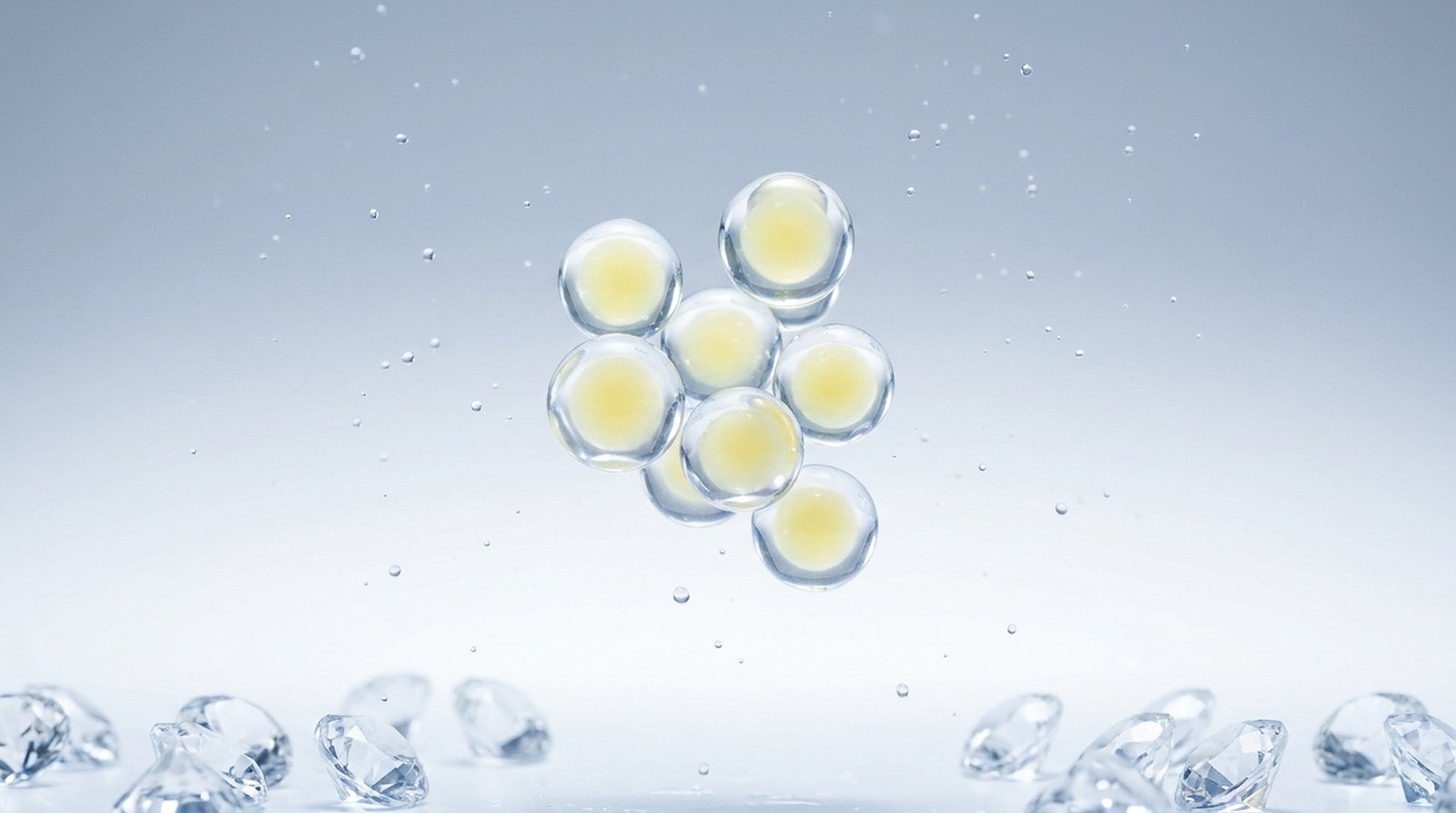
Liposomal vitamin C is ordinary ascorbic acid wrapped in a shell of phospholipid — the same class of fat your own cell membranes are built from. The wrapper is not the point. The point is what it does to how much of the vitamin reaches your blood, and that has now been measured in randomised human trials rather than asserted on packaging.
01 — The wrapper
What “liposomal” actually means
A liposome is a microscopic bubble whose wall is a double layer of phospholipid, with water inside. Vitamin C is water-soluble, so it sits in that watery centre, carried inside a fatty shell.
This matters because of how vitamin C normally gets in. Absorption in the gut runs through specific transporter proteins, and those transporters saturate. Past roughly 200 mg in a single dose, the proportion you absorb starts falling; by 1000 mg a substantial share is simply passed. That is the ceiling a liposome is trying to get around — a lipid-coated particle can cross the gut wall by a different route, one that does not queue for the same transporters.
The word is used loosely in supplements. “Liposomal” on a label can mean a genuine liposome, or it can mean vitamin C mixed with some lecithin. The only thing that separates the two is a measurement.
02 — The measurement
What the human trials found
The most direct test is a double-blind, placebo-controlled, randomised trial published in 2024. Twenty-seven adults took, on separate occasions, a placebo, 500 mg of standard vitamin C, and 500 mg of liposomal vitamin C. Blood was sampled over the following hours.
Higher peak plasma concentration for the liposomal form than the standard form, at the same 500 mg dose.
Leukocyte peak concentration rose 20% as well — white blood cells, which concentrate vitamin C far above plasma.
Increase in total exposure (area under the curve) in a separate randomised crossover trial in ten adults, at a 1000 mg dose.
Small trial. Consistent direction.
The range of peak-concentration advantages reported across nine studies in a 2025 scoping review.
Formulations differ, so the number that matters is the one measured on the product in your hand.
What the wrapper buys you. Same 500 mg dose, same people, measured on separate occasions:
- More reaches the blood. Peak plasma vitamin C ran 27% higher than the standard form — 8,610 against 6,271 ng/mL.
- More reaches the inside of cells. Peak levels in leukocytes ran 20% higher. White blood cells hold vitamin C far above blood levels, and the trial’s authors attribute the difference to better penetration and retention by those cells.
- More across the whole day. Total exposure over 24 hours was 21% higher, so it is a fuller curve rather than a taller spike.
- It gets past the ceiling. Plain vitamin C queues for gut transporters that saturate past roughly 200 mg. A lipid-coated particle crosses by another route, which is why a difference shows up at a 500 mg dose at all.
That third figure is the one to read carefully, because it is the one quoted selectively. A 5.4× result exists in the literature. So does a 1.2× result. They are different products. The review’s own conclusion was that liposomal forms are generally better absorbed and that the field needs better-standardised comparisons. A range should never be quoted as a single number.
03 — The skin part
What vitamin C does in skin, and what it does not
Vitamin C is not a skin ingredient in the way a moisturiser is. It is a cofactor: two enzymes that build collagen, prolyl and lysyl hydroxylase, cannot work without it. Without vitamin C the body makes collagen that does not hold its shape — which is what scurvy is, at the extreme.
That is why it is the one skin claim a European regulator has authorised in plain words. The permitted wording is that vitamin C “contributes to normal collagen formation for the normal function of skin”, and it applies to any product supplying at least 12 mg a day. Note what it says: normal function. Not brighter, not younger, not whiter.
Topical numbers do not transfer to oral
You will see it claimed that liposomal encapsulation increases skin penetration by roughly 1.7 to 2.1 times. That number is real, and it comes from topical studies — vitamin C applied onto skin in a cream or serum, measured passing through it.
It says nothing about a powder you swallow. Swallowed vitamin C reaches skin the same way it reaches everything else, through the bloodstream. Quoting a topical permeation figure on an oral supplement is one of the commonest sleights of hand in this category.
What oral vitamin C genuinely offers skin is supply. Skin holds one of the highest vitamin C concentrations in the body, and that store is drawn down by UV exposure and by smoking. Keeping it topped up is a real thing to do. It works over months, the way a nutrient does.
04 — The dose
600 mg, and why not more
A Lipo Crystal sachet carries 600 mg of liposomal vitamin C. For scale, the European nutrient reference value is 80 mg, so one sachet is 750% of it, and the EU tolerable upper intake guidance for adults sits at 1000 mg a day from supplements.
600 mg is also inside the range the bioavailability trials used — 500 mg and 1000 mg are the two doses those studies chose. That is the reason to pick it. Beyond about a gram, the extra is largely excreted, and in some people it brings loose stools with it.
In this formula the vitamin C sits alongside white tomato carotenoids and tocotrienol, which are fat-soluble and work in the lipid parts of a cell, while vitamin C works in the watery parts. That division of labour is the reason antioxidants are usually formulated together rather than alone.
Yes, in the trials that have measured it. A 2024 double-blind randomised trial in 27 adults found a 27 per cent higher peak plasma level for liposomal vitamin C than for standard vitamin C at the same 500 mg dose. A 2025 scoping review of nine studies found peak concentrations 1.2 to 5.4 times higher and total exposure 1.3 to 7.2 times higher. The spread is wide because formulations differ, so a specific number should never be assumed for a specific product.
No, and no food supplement should be sold on that idea. The authorised European wording for vitamin C and skin is that it contributes to normal collagen formation for the normal function of skin. Vitamin C is involved in pigment chemistry in laboratory work, but that is not the same as an oral dose lightening skin, and the human evidence for that does not exist.
600 mg of liposomal vitamin C per 3 g sachet, one sachet a day. That is 750 per cent of the European nutrient reference value of 80 mg, and below the 1000 mg a day upper guidance for supplemental vitamin C in adults.
Most people can. Vitamin C is acidic and high single doses can cause stomach discomfort or loose stools in people who are sensitive to it, which is more likely on an empty stomach. If that happens, take it with food. This is general information, not medical advice.