
Most supplement ingredients have never been tested on the thing they are sold for. This one has — twice, in randomised controlled trials, on people with prediabetes, measuring blood glucose directly. Here is what those trials found, and what the numbers do and do not say.
01 — The ingredient
What Eriomin® actually is
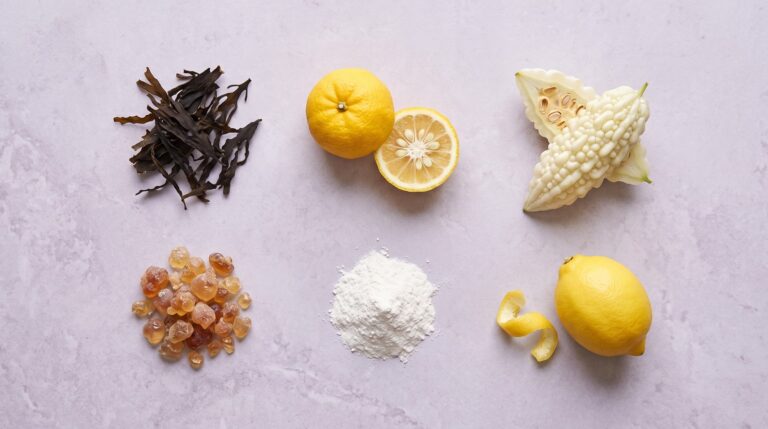
Eriomin® is a standardised citrus flavonoid complex produced by Ingredients by Nature. It is roughly 70% eriocitrin, with hesperidin, naringin and didymin making up most of the rest.
Eriocitrin is a flavonoid concentrated in lemon peel and juice. You have eaten it. What a standardised extract does is take a compound that appears in food in small and unpredictable amounts and deliver a known quantity of it, every time — which is the only way a trial can measure anything at all.
On the Kura Mynis carton it is named as Eriomin’ Lemon. This page is about that ingredient and the research published on it.
02 — The first trial
103 people with prediabetes, twelve weeks
Published in Phytotherapy Research in 2019. One hundred and three adults with prediabetes, average age 49, were randomly assigned to placebo or to Eriomin® at 200 mg, 400 mg or 800 mg a day, and followed for twelve weeks.
Across all three doses, the researchers reported significant reductions in blood glucose, insulin resistance, glucose intolerance and systolic blood pressure, together with reductions in three inflammatory markers — high-sensitivity C-reactive protein, interleukin-6 and TNF-α.
The result that stands out. By the end of the twelve weeks, 24% of the treated patients were no longer prediabetic — their blood glucose had returned to the normal range. And the lowest dose tested, 200 mg a day, was enough to produce the key benefits.
That is roughly one person in four, in a controlled trial, on a food-derived flavonoid. Three quarters of the treated group did not revert. But a quarter did, and that was measured against a placebo group rather than against how people felt.
03 — The second trial
The crossover study, and how it works
Published in the Journal of Medicinal Food in 2022. Thirty participants, double-blind, randomised, placebo-controlled and crossover — meaning every person took both Eriomin® and placebo in separate twelve-week periods, and acted as their own control. That design removes person-to-person variation entirely, which is why it can find an effect in thirty people that a parallel trial might need hundreds to see.
The dose was 200 mg a day — the low one.
| What was measured | Change | p-value | Significant? |
|---|---|---|---|
| Fasting blood glucose | −5% | ≤ 0.02 | Yes |
| GLP-1 | +17% | < 0.04 | Yes |
| Glucagon | −13% | < 0.001 | Yes |
| HbA1c | −2.1% | — | No |
| Insulin | −4% | — | No |
| HOMA-IR (insulin resistance) | −11% | — | No |
200 mg daily for 12 weeks, 30 participants, double-blind randomised placebo-controlled crossover. Figures as reported by the authors.
The authors’ own conclusion: intervention with Eriomin® “benefited the glycemic control of prediabetic and diabetic patients, with higher blood glucose levels, by increasing GLP-1 and decreasing systemic inflammation.”
Why GLP-1 is the interesting row
GLP-1 is a hormone your gut releases when you eat. It does three things: it tells the pancreas to release insulin when glucose is actually present, it slows how fast the stomach empties, and it reduces appetite.

You have heard of it recently for another reason. The newer weight-loss and diabetes injections work by imitating GLP-1 at pharmacological doses. This is not that. This is a food-derived flavonoid at 200 mg, and the effect is correspondingly modest — a 17% rise in the body’s own GLP-1, not a drug-level one. But it is the same lever, pulled gently, and it explains why fasting glucose moved.
04 — Reading it straight
What a 5% drop is, and what it is not
Five per cent is modest. Nobody should read it as a replacement for medication, for a doctor, or for what you eat. Three quarters of the 2019 group did not revert to normal glucose, HbA1c did not shift significantly, and insulin resistance moved only in a direction the statistics could not confirm.
What makes it worth writing about is not the size. It is that it exists at all:
That last point is worth dwelling on, because it is where most supplement ingredients fail. A fibre with good data at 30 g cannot deliver that data in a sachet. An extract with good data at 200 mg can.
05 — The dose in the sachet
200 mg — the same number, on our label
Everything above is about the ingredient. This is the part where it either transfers to a product or it does not, and the deciding number is on the back of the carton.
Kura Mynis ingredient declaration
Eriomin® Lemon
1% of a 20 g sachet
= 200 mg
The dose used in both published trials was 200 mg a day.
Read the ingredient list on the back of a Kura Mynis carton and you will find Eriomin® Lemon (1%). One per cent of a 20 g sachet is 200 milligrams — the exact amount given to participants in the 2019 and 2022 trials, taken once a day, for twelve weeks.
That is not a coincidence and we are not going to pretend it is. The formula was built to the dose the research used. You can check it yourself: the percentage is printed on every box, and the trial doses are in the papers listed below.
It is also the question worth asking of anything else on a shelf. An ingredient name on a label tells you a compound is present. A percentage tells you whether the research attached to that compound has anything to do with what you are holding.
06 — Where the research goes next
Two further studies
The work did not stop in 2022. A double-blind randomised controlled trial published in Food Science & Nutrition in 2023 looked at what Eriomin® does to the gut microbiome in prediabetes, reporting an effect on intestinal dysbiosis — which is consistent with a GLP-1 mechanism, since GLP-1 release begins in the gut.
In 2025, a randomised controlled trial in Frontiers in Nutrition tested the citrus flavonoid complex in prediabetic patients who were already taking metformin, reporting enhanced glycaemic and metabolic control. That is a harder test than a placebo comparison, because the participants were already on an effective drug.
07 — Before you start
Who should speak to a doctor first
Kura Mynis is a food supplement intended to complement a balanced diet. It is not a substitute for prescribed medication, and it should not be used to delay medical advice.
- If you take blood sugar medication. This matters more here than anywhere else on this site. Ingredients studied for effects on glucose can combine with medication that does the same job. Any change to a prescribed dose is a decision for your doctor or pharmacist, not for you and not for us.
- If you have been told you have prediabetes. Tell your doctor you are adding it, and keep the appointments you already have.
- If you are pregnant or breastfeeding. Consult your doctor before adding any supplement.
- Before surgery. Tell your surgical team about everything you take.
- If you monitor your glucose. Keep monitoring. A number you can see is worth more than a claim you have read — including this one.
08 — Sources
The papers referred to on this page
- Ribeiro CB, et al. Effectiveness of Eriomin® in managing hyperglycemia and reversal of prediabetes condition: a double-blind, randomized, controlled study. Phytotherapy Research. 2019. doi:10.1002/ptr.6386
- Cesar TB, Ramos FMM, Ribeiro CB. Nutraceutical eriocitrin (Eriomin) reduces hyperglycemia by increasing glucagon-like peptide 1 and downregulates systemic inflammation: a crossover-randomized clinical trial. Journal of Medicinal Food. 2022;25(11):1050–1058. doi:10.1089/jmf.2021.0181 · PMID 35796695
- Ramos FMM, et al. Lemon flavonoids nutraceutical (Eriomin®) attenuates prediabetes intestinal dysbiosis: a double-blind randomized controlled trial. Food Science & Nutrition. 2023. doi:10.1002/fsn3.3654
- Citrus flavonoid supplement enhances glycemic and metabolic control in prediabetic patients on metformin: a randomized controlled trial. Frontiers in Nutrition. 2025. doi:10.3389/fnut.2025.1639901
In published randomised controlled trials, yes. In a 2022 double-blind placebo-controlled crossover trial, 200 mg of Eriomin® a day for twelve weeks lowered fasting blood glucose by 5% (p ≤ 0.02) and raised GLP-1 by 17% (p < 0.04). In a 2019 trial of 103 adults with prediabetes, all doses significantly reduced blood glucose, insulin resistance and glucose intolerance, and 24% of treated patients returned to normal blood glucose. These are findings about the ingredient at the doses tested. Kura Mynis is a food supplement, not a medicine, and is not a substitute for prescribed treatment.
Eriomin® is a standardised citrus flavonoid complex made by Ingredients by Nature. It is about 70% eriocitrin, a flavonoid found in lemon peel and juice, with hesperidin, naringin and didymin making up most of the remainder. On the Kura Mynis carton it appears as Eriomin’ Lemon.
200 mg a day. The 2019 trial also tested 400 mg and 800 mg, and reported that the lowest dose — 200 mg — was sufficient to produce the key benefits, including the rise in GLP-1 and the reversal of hyperglycaemia in 24% of treated patients. Both trials ran for twelve weeks.
The ingredient declaration on the carton lists Eriomin® Lemon (1%). A Kura Mynis sachet is 20 g, so one per cent is 200 mg — the same daily dose used in both published trials, and the dose the 2019 study reported as sufficient. You can verify the percentage on any box.
No. GLP-1 medicines imitate the hormone at pharmacological doses and are prescribed and monitored by a doctor. Eriomin® is a food-derived citrus flavonoid, and what the trial measured was a 17% rise in the body’s own GLP-1 at 200 mg a day. Same lever, very different magnitude. It is not a medicine and not a replacement for one.
Ask your doctor or pharmacist before you start. Ingredients studied for effects on glucose can combine with medication that does the same job, and adjusting a prescribed dose is a medical decision. A 2025 randomised trial did test the citrus flavonoid complex in prediabetic patients already taking metformin, but that was a supervised trial — it is not a reason to combine them without telling your doctor.
Eriomin®, on this endpoint. It is the only ingredient in the formula with randomised controlled human trials reporting a statistically significant reduction in fasting blood glucose. InSea2® brown seaweed has a significant result on insulin rather than glucose, and inositol has good evidence at 2–4 g a day in specific populations. We set all of it out, including the results that were not significant, on the ingredients research page.