Most blood sugar supplements ask you to take their word for it. This one does not. The lead ingredient in Kura Mynis has been through two randomised controlled trials on people with prediabetes — and in the first of them, 24% of participants were no longer prediabetic after twelve weeks. Here is every study behind the formula.
01 — The lead ingredient
Eriomin®: two trials, one dose, real numbers
Eriomin® is a standardised citrus flavonoid complex, roughly 70% eriocitrin, produced by Ingredients by Nature. Eriocitrin is concentrated in lemon peel. You have eaten it — what a standardised extract does is deliver a known amount every time, instead of whatever happens to be in the fruit.
It is the reason Eriomin® is named on the front of the box.
The 2019 trial — 103 adults, twelve weeks
Published in Phytotherapy Research, 2019 — open access, PMID 31183921. One hundred and three adults with prediabetes, average age 49, randomly assigned to placebo or Eriomin® at 200 mg, 400 mg or 800 mg daily.
After twelve weeks, 24% of the treated group were no longer prediabetic. Their blood glucose had returned to the normal range.
And it happened at 200 mg — the lowest dose tested. Tripling and quadrupling the dose did not do more. That matters, because it means the effective amount is small enough to put in a daily drink.
The 2022 trial — the crossover study
Published in the Journal of Medicinal Food, 2022 — open access, PMID 35796695. Thirty participants, double-blind randomised placebo-controlled crossover — the design where every participant acts as their own control, which removes the biggest source of noise in a small trial. Same dose: 200 mg daily, twelve weeks.
| What was measured | Change | p-value |
|---|---|---|
| Fasting blood glucose | −5% | 0.02 |
| GLP-1 | +17% | 0.04 |
| Glucagon | −13% | 0.001 |
| HOMA-IR (insulin resistance) | −11% | — |
| Insulin | −4% | — |
| HbA1c | −2.1% | — |
Eriomin® 200 mg daily, 12 weeks, 30 participants. Journal of Medicinal Food, 2022;25(11):1050–1058. The top three results reached statistical significance.
The GLP-1 figure is the interesting one. GLP-1 is the hormone your gut releases after a meal to tell the pancreas to release insulin and tell your brain you have had enough. A 17% rise means your own hormone, raised by a compound from citrus peel, at a dose you can take every day.
The authors’ own conclusion: “intervention with Eriomin benefited the glycemic control of prediabetic and diabetic patients… by increasing GLP-1 and decreasing systemic inflammation.”
02 — The enzyme ingredient
InSea2®: slowing the starch before it becomes sugar
Rice does not enter your blood as rice. Two enzymes take it apart first: alpha-amylase breaks the starch chain into fragments, and alpha-glucosidase snips those fragments into single glucose molecules small enough to cross into the bloodstream. Only then does blood sugar rise.
InSea2® is a proprietary extract of two species of North Atlantic brown seaweed, standardised to a defined phlorotannin content and made by a documented solvent-free extraction. Those two enzymes are exactly what it is developed and studied to slow down.
This is the second-largest ingredient in the formula at 17.5%, and it is why Kura Mynis is taken before the meal rather than after. An enzyme inhibitor has to be in place before the starch arrives. Taken afterwards, the work is already done.
03 — The rest of the formula
What each remaining ingredient is there to do
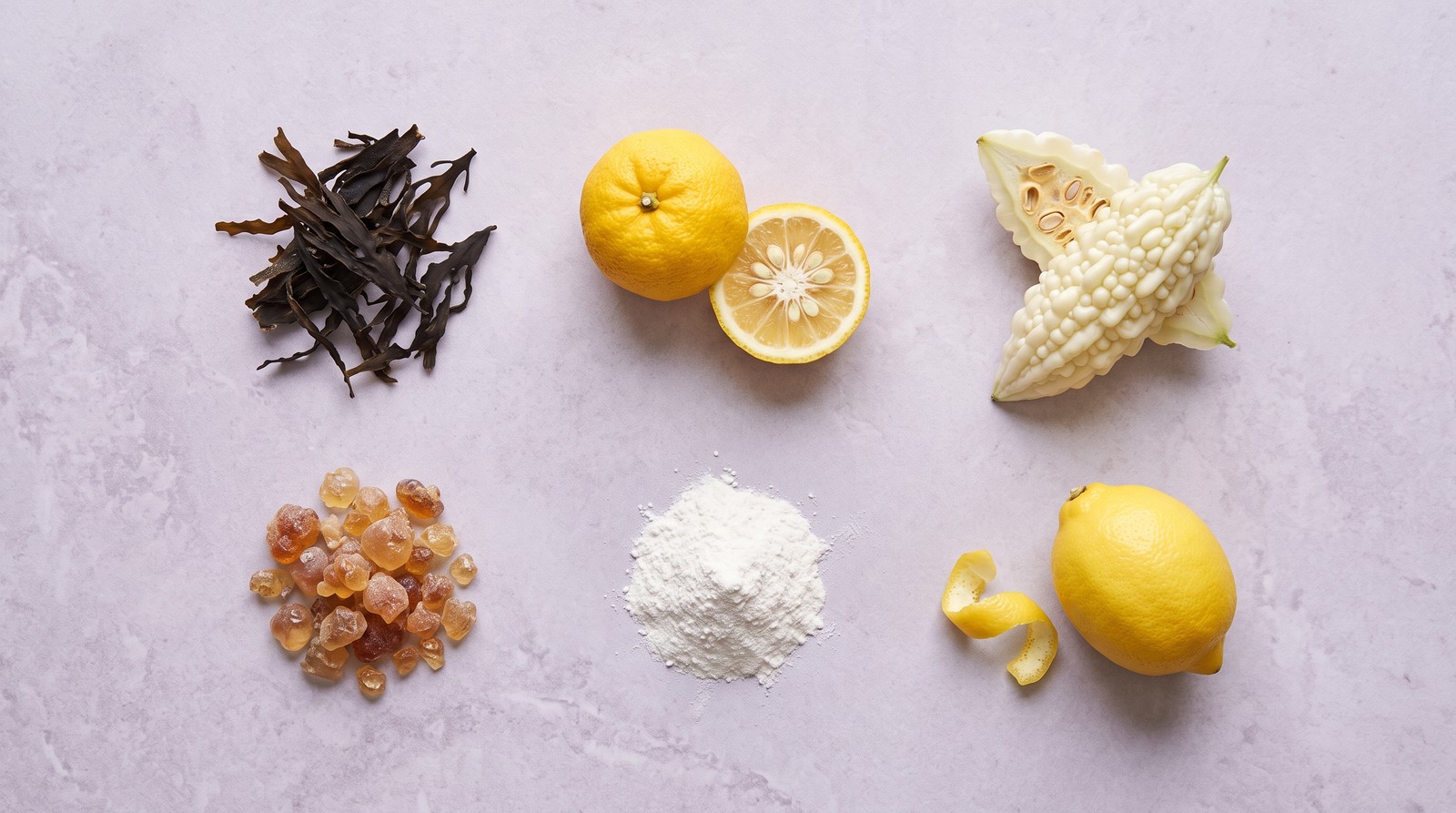
White bitter melon extract (6%) — one of the most studied plants in blood sugar research, and a traditional food across South and Southeast Asia. Its charantin content is the focus of an active research literature. What the trials measured →
Yuzu extract (22.5%) — the largest ingredient by weight. Made from the peel of the Japanese citrus, where the flavonoids concentrate: hesperidin and naringin. It also gives the drink its taste. The composition and the research →
Caralluma fimbriata (5.5%) — an edible succulent with a long history as a famine food in India, studied for its effect on appetite.
Inositol — a sugar alcohol your own cells make, structurally an isomer of glucose. It works as a second messenger inside the insulin signalling pathway. What inositol is and does →
Acacia gum — a soluble dietary fibre that dissolves without thickening. Each 20 g sachet carries 5 g of soluble fibre, and soluble fibre slows gastric emptying — the rate at which a meal leaves the stomach. The fibre behind the sachet →
Sixteen trace minerals — including chromium, selenium, zinc and magnesium, declared on the label. Chromium in particular has a long literature in glucose metabolism.
These ingredients are in the formula for their compound profile and their history as foods. The trial evidence above sits with Eriomin®.
04 — The finished formula
Laboratory tested at Lincoln University College
The trials above tested ingredients. This one tested Kura Mynis itself — the finished formula, assessed at the School of Pharmacy, Lincoln University College and reported in January 2026, using cell cultures and a preclinical model under published international protocols.
| Test | Result |
|---|---|
| Human cell viability at 100 µg/ml | 91.66% still viable at 24 hours |
| IC50 across 20–100 µg/ml | Never reached |
| Acute oral tolerance, OECD 423 | No observable effect at 6,000 mg/kg |
| Twelve observational parameters | Normal or absent at every timepoint |
School of Pharmacy, Lincoln University College, January 2026. MTT assay and OECD Test Guideline 423.
IC50 is the standard way toxicity gets reported: the dose that kills half the cells in a culture. Across the entire range tested, Kura Mynis never reached it. There is no half-lethal dose to report because the tests never found one.
OECD 423 uses 6,000 mg/kg as an upper limit for a reason — the protocol does not routinely go higher, because a substance that causes nothing at that level will not tell you more at a larger one. The gap between a normal daily serving and a dose that produced no observable effect at all is very wide.
05 — On one page
The evidence, summarised
| What | Study | Finding |
|---|---|---|
| Eriomin® 200 mg/day | 103 adults with prediabetes, 12 weeks, RCT, 2019 | 24% returned to normal glucose |
| Eriomin® 200 mg/day | 30 adults, double-blind crossover, 12 weeks, 2022 | Fasting glucose −5%, GLP-1 +17%, glucagon −13% |
| Kura Mynis, finished formula | Lincoln University College, 2026 | 91.66% cell viability, no IC50 |
| Kura Mynis, finished formula | OECD 423 acute oral tolerance | No observable effect at 6,000 mg/kg |
| Per 20 g sachet | Declared nutrition panel | 0 g sugar, 5 g soluble fibre, 40 kcal |
06 — What it adds up to
Why we publish the numbers
Two randomised controlled trials, on people, measuring blood glucose directly, at a dose small enough to fit in a daily sachet — that is more human evidence than most products on this shelf can point to, and we would rather show you the p-values than ask you to trust an adjective.
The formula around that ingredient is built on foods: citrus peel, seaweed, bitter melon, soluble fibre, trace minerals. It has been laboratory tested and is well tolerated far above any realistic serving.
One thing to be clear about, because it matters: the trials above tested ingredients at specific doses in specific groups of people. Kura Mynis is a food supplement — not a medicine, and not a treatment for any condition. If your blood sugar is a concern, your doctor is the person to talk to. Kura Mynis is what you take alongside that conversation, not instead of it.