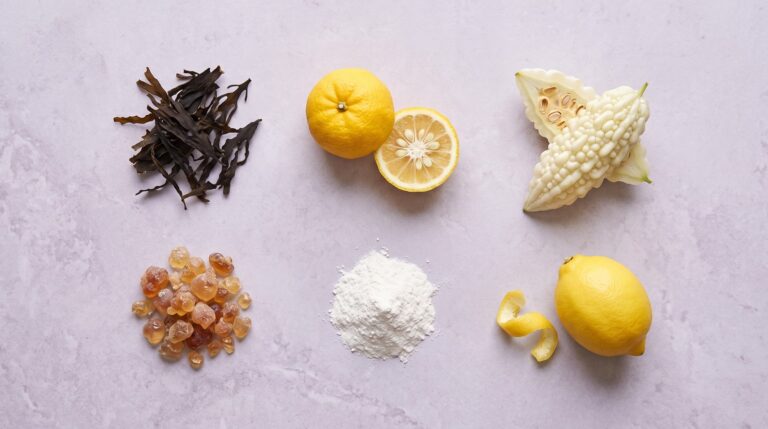

A bowl of white rice is about 45 g of starch. Your body cannot absorb starch — it has to be cut into glucose first, and two enzymes do the cutting. Here is how that works, and what the published research says about the ingredients that have been studied at that step.
01 — The biology
What actually happens to the rice you just ate
Starch is a chain of glucose molecules linked together. It is far too large to cross the wall of your intestine, so nothing happens until it is broken apart. Two enzymes do that job, one after the other.

From the bowl to the bloodstream
How fast that second step happens decides how quickly glucose arrives in the bloodstream after a meal — and therefore how much insulin the body releases to deal with it. This is ordinary human physiology, the same in everyone.
It is also the step that pharmacologists have targeted for decades, and the step where several food-derived compounds have been studied. That is the whole reason a pre-meal drink is taken before the meal rather than after it: by the time the food is down, the enzymes have already started.
02 — The strongest evidence
InSea2®: what a Canadian university trial measured
InSea2® is a standardised extract of two North Atlantic brown seaweeds, Ascophyllum nodosum and Fucus vesiculosus, selected for its phlorotannin content. Phlorotannins are the compounds with documented inhibitory action on both of the enzymes above.
It was tested at the Institute of Nutraceuticals and Functional Foods at Laval University, and published in Applied Physiology, Nutrition, and Metabolism in 2011. Twenty-three healthy adults took 500 mg of the extract, or a placebo, thirty minutes before eating 50 g of carbohydrate as bread. The design was double-blind, randomised and crossover — meaning every participant took both the extract and the placebo on separate occasions, and acted as their own control. That is a stronger design than two separate groups, because it removes person-to-person variation entirely.
| What was measured | Versus placebo | p-value |
|---|---|---|
| Insulin needed for the same meal (incremental AUC) | −12.1% | 0.04 |
| Insulin sensitivity (Cederholm index) | +7.9% | < 0.05 |
Single 500 mg dose, 30 minutes before 50 g of carbohydrate. 23 adults, double-blind randomised crossover. Figures as reported by the authors.
Read the first row again, because it is easy to skim past: the same meal, the same carbohydrate, and the body released around 12% less insulin to handle it. The second row says the insulin that was released worked better.
A p-value of 0.04 means a result this size would come up by chance about four times in a hundred. The conventional threshold for calling a finding statistically significant is 0.05, so both of these clear it. The plasma glucose response in the same trial did not change significantly — which is consistent with the proposed mechanism, since slowing the release of glucose is not the same thing as removing it.
03 — The formula
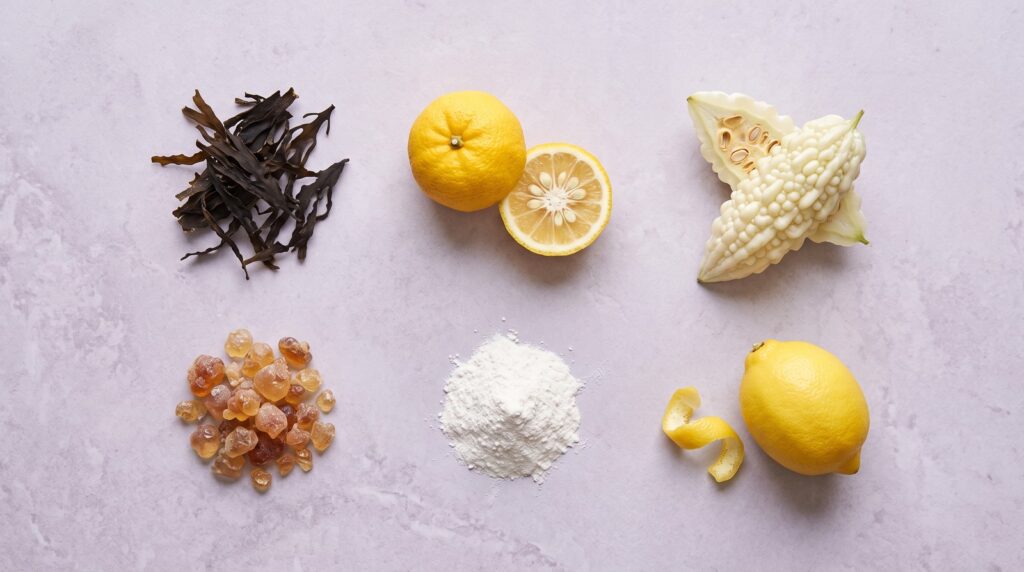
The rest of the formula, and what each is there for
Each of these has its own page with the full research summary, including the results that were not significant. We publish those too.
| Ingredient | What it is | Detail |
|---|---|---|
| Acacia gum | A soluble dietary fibre that dissolves without thickening — which is why the drink stays drinkable rather than turning to gel. | Read more |
| Inositol | A cellular second messenger, used here as myo-inositol. Also found naturally in whole grains. | Read more |
| White bitter melon | A traditional food crop across Malaysian, Indian and Chinese cooking, and an active research area. We do not build claims on it. | Read more |
| Yuzu extract | Made from the peel. It carries hesperidin and naringin, and it is what gives the drink its taste. | Read more |
| InSea2® brown seaweed | A branded extract of two brown seaweeds, standardised to a defined composition and studied for its effect on the enzymes that break starch down into sugar. | Read more |
| Eriomin® lemon extract | A branded, standardised citrus flavonoid extract rich in eriocitrin. This is the ingredient the pack names as Eriomin’ Lemon. | Read more |
| Caralluma fimbriata | An edible succulent long eaten as a vegetable in southern India. Named on the pack alongside the extracts above; we do not build claims on it. | — |
One 20 g sachet, taken thirty minutes before a meal.
Six ingredients, as declared on the carton
One sachet is 20 g. Percentages are the manufacturer’s own ingredient declaration.
A standardised citrus flavonoid, 70% eriocitrin. 200 mg is the exact daily dose used in both published randomised controlled trials.
p ≤ 0.02
p < 0.04
returned to normal glucose
Per 20 g sachet, the label declares 40 kcal, zero sugars, 10 g carbohydrate, 5 g soluble fibre, 80 mg calcium and 15 mg sodium.
04 — How to judge any supplement
The question worth asking about dose
A trial result belongs to the amount that was tested, not to the ingredient name. This is the single most useful thing to understand when comparing supplements, and almost nobody explains it.
| Ingredient | Dose used in the published trial | What that is | In one Kura Mynis sachet |
|---|---|---|---|
| Eriomin® lemon | 200 mg per day | a fifth of a gram | 1% — 200 mg match |
| InSea2® brown seaweed | 500 mg, taken 30 minutes before the meal | half a gram | 17.5% — 3.5 g |
| Myo-inositol | 2–4 g per day | half to one teaspoon | listed, percentage not declared |
| Bitter melon extract | 2.4 g per day over 12 weeks | about half a teaspoon | 6% — 1.2 g |
| Acacia gum | 20–40 g | two to four tablespoons | listed as thickener; total soluble fibre 5 g |
Use this on every label you pick up, ours included. How much of each ingredient is in one serving, and how does it compare with the trial? An ingredient list that names a compound without naming the amount is telling you what is in the room, not how loudly it is speaking.
Our own answer is in the first row. Eriomin® is declared at 1% of a 20 g sachet — 200 mg — which is exactly the daily dose used in both published trials. The percentage is printed on every carton, so you do not have to take our word for it. The fibre doses, at 20 g and up, are food-scale and no sachet reaches them; a Kura Mynis sachet carries 5 g of soluble fibre in total.
05 — Before you start
Who should speak to a doctor first
We would rather you check than assume. Kura Mynis is a food supplement intended to complement a balanced diet — it is not a treatment for any condition, not a substitute for prescribed medication, and not a reason to delay medical advice.
- If you take blood sugar medication. Speak to your doctor or pharmacist first. Effects can combine, and any change to a prescribed dose is a medical decision, not a supplement decision.
- If you have a thyroid condition. Brown seaweed is naturally rich in iodine, and iodine directly affects thyroid function. Ask first.
- If you are pregnant or breastfeeding. Bitter melon is traditionally avoided in pregnancy. Consult your doctor.
- Before surgery. Tell your surgical team about every supplement you take.
- If you monitor your glucose. Keep monitoring, and keep your doctor in the loop.
06 — Sources
The papers referred to on this page
- Paradis ME, Couture P, Lamarche B. A randomised crossover placebo-controlled trial investigating the effect of brown seaweed (Ascophyllum nodosum and Fucus vesiculosus) on postchallenge plasma glucose and insulin levels in men and women. Applied Physiology, Nutrition, and Metabolism. 2011;36(6):913–919. doi:10.1139/h11-115 · PMID 22087795
- Momordica charantia (bitter melon) efficacy and safety on glucose metabolism in Korean prediabetes participants: a 12-week, randomized clinical study. Food Science and Biotechnology. 2022;32(5):697–704. doi:10.1007/s10068-022-01214-9 · PMID 37009042
- Acacia Gum Is Well Tolerated While Increasing Satiety and Lowering Peak Blood Glucose Response in Healthy Human Subjects. Nutrients. 2021;13(2):618. doi:10.3390/nu13020618
- Effects of inositol on glucose homeostasis: systematic review and meta-analysis of randomized controlled trials. Clinical Nutrition.
Because the enzymes that break starch down start working the moment food is in your mouth. The published trial on InSea2® brown seaweed gave the extract thirty minutes before the carbohydrate, and that is the timing Kura Mynis follows: one sachet, thirty minutes before a meal.
In a double-blind randomised crossover trial of 23 adults at Laval University, published in Applied Physiology, Nutrition, and Metabolism in 2011, a single 500 mg dose taken 30 minutes before a 50 g carbohydrate meal was associated with a 12.1% lower insulin incremental area under the curve (p = 0.04) and a 7.9% higher Cederholm index of insulin sensitivity (p < 0.05). The plasma glucose response was not significantly changed. This is research on the ingredient, not on Kura Mynis.
α-amylase, released in saliva and from the pancreas, breaks long starch chains into shorter fragments. α-glucosidase, on the wall of the small intestine, makes the final cut into single glucose molecules that can be absorbed. How quickly that second step happens shapes how fast glucose arrives after a meal.
Because a published result belongs to the amount that was tested, not to the ingredient name. The seaweed trial used 500 mg. Inositol trials use 2–4 g a day. Acacia gum studies use 20–40 g. A product containing a small fraction of those amounts has not inherited the result, even if the ingredient list looks identical — which is why the amount on the label matters as much as the name.
The pack names it as a botanical yuzu beverage with brown algae extract, white bitter melon extract, Caralluma fimbriata extract and Eriomin® lemon. The brown algae extract is InSea2®, standardised from Ascophyllum nodosum and Fucus vesiculosus. The formula also carries myo-inositol and acacia gum, a soluble dietary fibre. One 20 g sachet is taken thirty minutes before a meal.
Kura Mynis is made in Malaysia, at a facility in Sungai Buloh, Selangor that holds US FDA food-facility registration, FSSC 22000, GMP, HACCP and MeSTI certification. The ingredients are sourced internationally — InSea2® is a brown-seaweed extract from the North Atlantic — while blending, sachet filling and packing all happen in Malaysia.