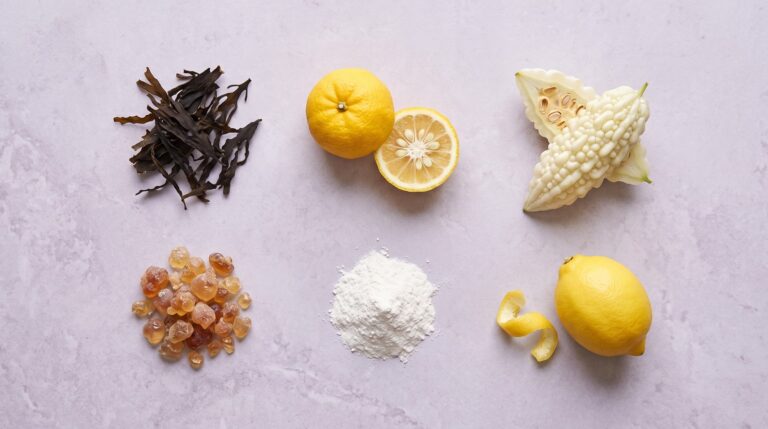
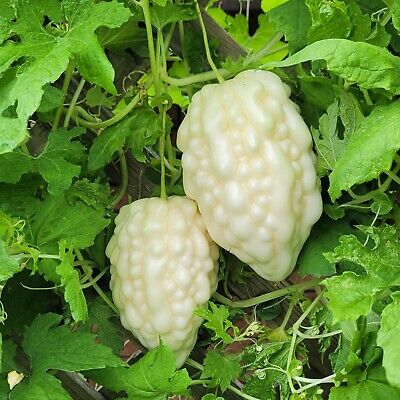
White bitter melon is a pale variety of Momordica charantia, the gourd eaten as a vegetable across Asia and used in traditional medicine for generations. It is one of the most studied plants in blood sugar research and one of the most over-claimed. This page sets out what the published trial actually measured, including the results that did not reach statistical significance.
What this page is. A summary of published research on the ingredient white bitter melon. It is not a description of what Kura Mynis does, and nothing here is a medical claim. Kura Mynis is a food supplement, not a medicine, and is not intended to diagnose, treat, cure or prevent any disease.
01 — The plant
What is white bitter melon?
White bitter melon is a pale-skinned variety of Momordica charantia, a climbing vine in the Cucurbitaceae family grown across Africa, Asia and South America. Nutritionally it is broadly equivalent to the more familiar green bitter gourd — the difference is colour, not composition.
It is a long-standing food crop in Malaysian, Indian and Chinese cooking, where it is eaten as a vegetable. That culinary history is worth keeping in mind: a food with centuries of everyday use is a reasonable thing to concentrate into a supplement, but tradition on its own is not clinical evidence.
02 — Composition
Which compounds are researchers interested in?
Two cucurbitane-type triterpenoids appear most often in the literature, both found in the fruit, leaves and seeds:
Laboratory work on these compounds is ongoing. Findings from cell and animal studies do not automatically carry over to people, which is why human trials matter more than compound lists.
03 — The human data
What did the 12-week human trial actually find?
A 12-week placebo-controlled study in adults aged 18 to 80 with pre-diabetes measured glucose and insulin markers during an oral glucose tolerance test (OGTT). Below are the reported changes from baseline. A more negative number means a larger decrease.
| Marker | Bitter melon | Placebo | p-value | Significant? |
|---|---|---|---|---|
| Fasting glucose (mg/dL) | −1.03 ± 1.32 | −2.53 ± 3.47 | — | No |
| Glucose at 120 min (mg/dL) | −7.43 ± 27.6 | −4.01 ± 40.3 | 0.396 | No |
| HOMA-IR | −0.153 ± 1.200 | −0.293 ± 1.490 | 0.865 | No |
| Matsuda index | −0.031 ± 5.82 | −0.106 ± 1.378 | 0.571 | No |
| Glucagon (pg/mL) | −92.17 ± 44.70 | −45.99 ± 20.28 | 0.101 | No |
Changes from baseline over 12 weeks. Conventional significance threshold is p < 0.05. Figures as reported in the published trial.
Read that table honestly. On glucose at 120 minutes and on glucagon, the bitter melon group changed more in the expected direction. On fasting glucose and HOMA-IR, the placebo group changed more. On the Matsuda index both groups declined slightly. And none of the between-group differences reached statistical significance — the smallest p-value in the set is 0.101, well above the 0.05 threshold.
04 — Interpretation
What does “not statistically significant” mean here?
A p-value estimates how likely a difference this large would be if the supplement had no real effect. The conventional threshold is 0.05. A p-value of 0.396 means a result like that would turn up roughly four times in ten by chance alone, so it cannot be presented as evidence that the supplement worked.
It does not prove the supplement failed either. A 12-week trial in a pre-diabetic population may simply be too small or too short to detect a modest effect. The accurate summary is that this trial did not demonstrate a significant benefit, and larger studies are needed.
We are stating this plainly because much bitter melon marketing does not. You will find pages quoting these same numbers as proof of a “significant glucose-lowering effect”. The numbers do not support that sentence, and we would rather you heard it from us than found out later.
05 — In the formula
Why is white bitter melon in Kura Mynis?
It is included as one component of a multi-ingredient formula, chosen for its long history as a food and for the volume of ongoing research into its compounds — not because any single trial has established an effect.
Kura Mynis is a food supplement intended to complement a balanced diet. It is not a treatment for diabetes or pre-diabetes, it is not a substitute for prescribed medication, and it should not be used to delay medical advice. If you are monitoring your blood sugar, that monitoring belongs with your doctor.
06 — Cautions
Who should be careful with bitter melon?
- Anyone taking blood-sugar medication. Speak to your doctor or pharmacist before adding any supplement, as effects may combine.
- Pregnant or breastfeeding. Bitter melon is traditionally avoided during pregnancy. Consult your doctor first.
- Before surgery. Tell your surgical team about every supplement you take.
- Children. Kura Mynis is formulated for adults.
Research is ongoing and results are mixed. In the 12-week human trial summarised above, none of the differences between the bitter melon group and the placebo group reached statistical significance. Bitter melon should not be relied on to manage blood sugar, and it is not a replacement for medical treatment.
They are varieties of the same species, Momordica charantia. White bitter melon has paler skin and is generally milder in taste, but it is nutritionally comparable to the common green variety.
Ask your doctor or pharmacist first. Supplements can interact with prescribed medicines, and any change to blood sugar management needs to be supervised by the person treating you. Never stop or adjust prescribed medication on your own.
The two most studied are charantin, a steroidal saponin mixture, and momordicin, the triterpenoid behind its bitterness. Both are found in the fruit, leaves and seeds, and both are the subject of continuing laboratory research.
Disclaimer. This article is for general information only and is not medical advice. Kura Mynis is a food supplement and is not intended to diagnose, treat, cure or prevent any disease. Individual results vary. Consult a qualified healthcare professional before starting any supplement, particularly if you are pregnant, breastfeeding, taking medication or managing a diagnosed condition.