InSea2® is a branded brown seaweed extract, standardised to a defined composition and made by a documented extraction method rather than being generic seaweed powder. It is studied for its effect on the enzymes that break starch down into sugar. This page explains what it is — and why we removed a set of trial figures that used to appear here.
What this page is. Background on the ingredient InSea2® and on fucoxanthin. It is not a description of what Kura Mynis does. Kura Mynis is a food supplement, not a medicine, and is not intended to diagnose, treat, cure or prevent any disease.
01 — The ingredient
What is InSea2®?
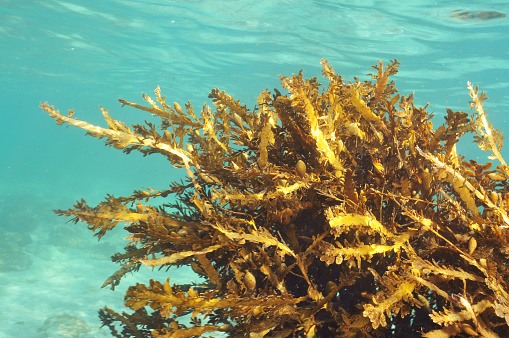
InSea2® is a proprietary extract combining two species of brown seaweed harvested from the North Atlantic:
Both are edible seaweeds with a history of food and agricultural use. Being a branded ingredient means the blend ratio, extraction method and polyphenol concentration are specified and consistent between batches — which is a genuine advantage over a generic “seaweed extract” of unstated composition.
02 — Processing
How is it extracted?
InSea2® is produced by an aqueous extraction process — water-based, without organic solvents, excipients or additives. The purpose is to concentrate the seaweed’s naturally occurring polyphenols.
In brown algae these polyphenols are predominantly phlorotannins, a class found almost exclusively in seaweed and not in land plants. The harvesting is described by the supplier as eco-responsible, with managed harvest cycles intended to allow the seaweed beds to regenerate.
A solvent-free process is worth noting on its own terms: it means no residual solvent to remove, and it is one of the more straightforward things to verify about a supplement ingredient.
03 — Fucoxanthin
What is fucoxanthin?
Fucoxanthin is the most abundant carotenoid in brown macroalgae, and it is what gives brown seaweed its olive-brown colour by masking the green of chlorophyll. Carotenoids as a group are the pigments behind much of the colour in carrots, tomatoes and leafy greens.
It is an active subject of metabolic research, and human studies have been conducted. Reported effects have generally been modest in size, and the research base remains small relative to more established nutrients. It is an ingredient worth following, not a settled one.
04 — A correction
Why we removed the HbA1c figures from this page
An earlier version of this article cited a six-month study, describing participants as adults with type 2 diabetes and reporting a baseline HbA1c of approximately 5.1%, falling to 4.9%.
Those two statements cannot both be correct. HbA1c is the standard marker of average blood glucose over roughly three months, and the diagnostic threshold for diabetes is 6.5% or above. A value of 5.1% is within the normal, non-diabetic range. A group of people with type 2 diabetes could not have a baseline of 5.1%.
Either the population was described incorrectly or the figures were transcribed incorrectly. We do not currently know which, so we have taken the numbers down rather than republish data we cannot stand behind. If we are able to verify the original source, we will restore a corrected version with a proper citation.
We are explaining this rather than quietly deleting it because anyone who read the earlier version deserves to know it was wrong. A page that only ever gets more confident is not a page worth trusting.
05 — In the formula
Why is InSea2® in Kura Mynis?
It is included as one component of a multi-ingredient formula, selected as a standardised, traceable ingredient with a defined extraction process rather than a generic seaweed powder.
Kura Mynis is a food supplement intended to complement a balanced diet. It is not a treatment for diabetes or any other condition, and it is not a substitute for prescribed medication.
06 — Cautions
Who should be careful with brown seaweed?
This section matters more than it does for most ingredients, so please read it.
- Thyroid conditions. Brown seaweeds, including bladderwrack, are naturally rich in iodine, and iodine intake directly affects thyroid function. If you have a thyroid condition or take thyroid medication, speak to your doctor before taking any seaweed-derived supplement.
- Pregnant or breastfeeding. Iodine requirements change during pregnancy and breastfeeding. Kura Mynis is not formulated for use at these times.
- Other iodine sources. If you already take an iodine supplement or eat seaweed regularly, mention it to your doctor.
- Seafood or seaweed allergy. Avoid if you react to marine ingredients.
Two North Atlantic brown seaweeds: Ascophyllum nodosum (knotted wrack) and Fucus vesiculosus (bladderwrack). They are processed by a water-based extraction without solvents, excipients or additives, to concentrate the seaweed’s natural polyphenols.
Yes. Brown seaweeds are naturally rich in iodine, which is why anyone with a thyroid condition, on thyroid medication, or already taking iodine should speak to their doctor before using a seaweed-derived supplement.
The most abundant carotenoid in brown macroalgae, and the pigment that gives brown seaweed its olive-brown colour. It is an active area of metabolic research, though reported effects have been modest and the human research base is still small.
The main class of polyphenols in brown algae. Unlike most dietary polyphenols they are found almost exclusively in seaweed rather than in land plants, which is why seaweed extracts are studied separately from fruit and vegetable polyphenols.
Disclaimer. This article is for general information only and is not medical advice. Kura Mynis is a food supplement and is not intended to diagnose, treat, cure or prevent any disease. Individual results vary. Consult a qualified healthcare professional before starting any supplement, particularly if you are pregnant, breastfeeding, taking medication or managing a diagnosed condition. InSea2® is a registered trademark of its respective owner.