Lipo Crystal declares ten actives on a three-gram sachet, and prints the amount of every one of them. This page takes each amount and puts it next to the dose used in the published human research, so you can compare the two yourself.
01 — The label
What is actually in a sachet
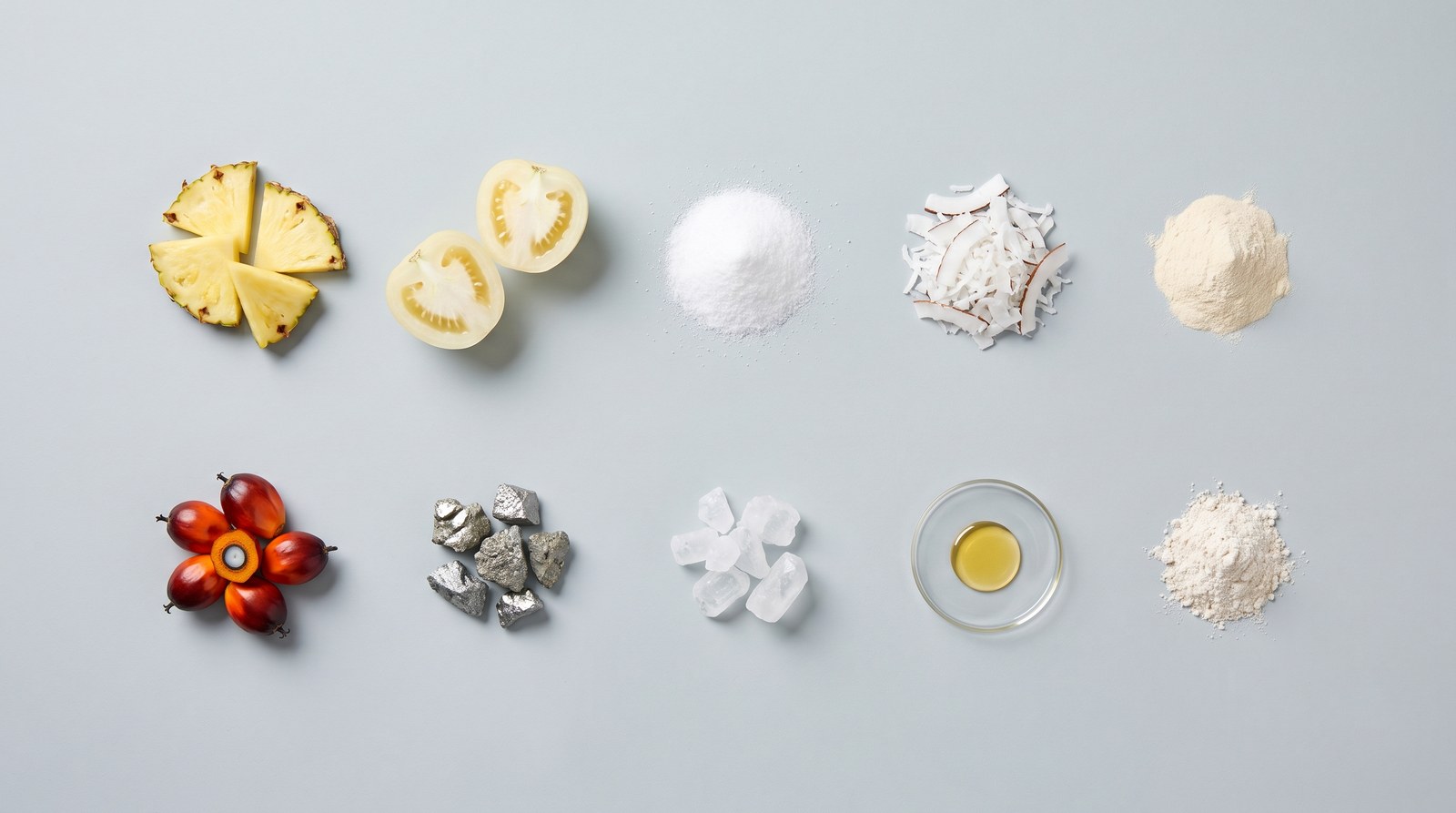
This is the declared list, in descending order of amount. Nothing here is a range, a “proprietary complex”, or a total for a blend — each figure belongs to one named ingredient.
| Active | Per 3 g sachet | What it is there for |
|---|---|---|
| Pineapple bromelain | 1250 mg | A protein-digesting enzyme group from pineapple, studied for swelling and inflammation. |
| Liposomal vitamin C | 600 mg | The cofactor your body cannot make collagen without. |
| Herbosomal® white tomato | 500 mg | Phytoene and phytofluene — the two colourless carotenoids. |
| Virgin coconut oil powder | 100 mg | Medium-chain fat. In a formula like this it is mostly a carrier. |
| Enzyme premix | 100 mg | A blend. See the note at the end of this page. |
| Calcium | 50 mg | A mineral with a real role inside skin, and a small amount of it here. |
| Yeast beta-glucan | 50 mg | A cell-wall polysaccharide from baker’s yeast, studied for immune response. |
| Tocotrienol | 20 mg | The less common half of the vitamin E family. Malaysia’s own research story. |
| Zinc | 5 mg | A mineral the skin genuinely needs. Read the dose note. |
| Liposomal vitamin D3 | 2000 IU | 50 µg. A real dose, not a token one. |
The sachet also contains silica (21 mg), erythritol (200 mg) and sucralose (20 mg). Those are not actives — silica is an anti-caking agent that keeps a powder pourable, and the other two are sweeteners. We have listed them here because leaving them out of an ingredients page would be the same trick as hiding a dose.
02 — The comparison
Our amount, against the amount the trials used
An ingredient list tells you what is in the tin. It does not tell you whether there is enough of it to matter. The only way to answer that is to find the published human trials, read what dose they gave, and put the two numbers side by side. Here they are.
| Active | Ours | Human trials used | How it compares |
|---|---|---|---|
| Liposomal vitamin C | 600 mg | 500–1000 mg in the bioavailability trials | In range. 750% of the EU nutrient reference value. |
| Liposomal vitamin D3 | 2000 IU | 1000–2000 IU/day in the skin trials | At the top of the range. |
| Herbosomal® white tomato | 500 mg | See the white tomato pages | The formula’s reason for existing. |
| Pineapple bromelain | 1250 mg extract | 200–1050 mg/day of bromelain | Bromelain-rich pineapple extract. |
| Yeast beta-glucan | 50 mg | 7.5–1500 mg/day, immune endpoints | Inside the studied range. |
| Tocotrienol | 20 mg | Oral skin trials are scarce | Published skin work on vitamin E is mostly topical. |
| Zinc | 5 mg | 20–30 mg elemental in the acne trials | Half the EU nutrient reference value for zinc. |
| Calcium | 50 mg | ~1000 mg/day is the adult requirement | A supporting mineral in the formula. |
| Virgin coconut oil | 100 mg | Skin trials are topical, in grams | Carries the fat-soluble actives. |
| Enzyme premix | 100 mg | — | Composition to be published. |
Notes on three of the amounts
Zinc. The randomised trials that tested zinc against acne used 20–30 mg of elemental zinc a day. A Lipo Crystal sachet has 5 mg. That is half the European nutrient reference value for zinc, a real nutritional contribution to normal skin.
Calcium. The sachet carries 50 mg of calcium, against an adult daily requirement of about 1000 mg.
Virgin coconut oil. The 100 mg of medium-chain fat is there to help the fat-soluble ingredients next to it — the carotenoids, tocotrienol and vitamin D3 — get absorbed. That is what it is included for.
03 — The open questions
Two figures still to come
How much bromelain is in 1250 mg of pineapple extract. Bromelain is measured in enzyme activity units, not milligrams, and a pineapple extract can be anywhere from a few per cent bromelain to a highly concentrated preparation. The trials that reduced swelling and inflammation used 200–1050 mg of bromelain per day. Until the activity figure for our extract is published here, the sachet contains 1250 mg of bromelain-rich pineapple extract, and that activity figure will be published here once the manufacturer supplies it.
What is in the enzyme premix. 100 mg of a blend, with the components not named. The composition will be published here once the manufacturer supplies it.
Both are being asked of the manufacturer. When the answers arrive they will appear on this page, whichever way they fall.
04 — Read further
One page per ingredient
Each of these sets out what the ingredient is, what the published human research measured, and where that research stops.
- Herbosomal® white tomatoPhytoene and phytofluene, the two carotenoids with no colour, and what a 500 mg dose is based on. There is also a page on the laboratory data for the finished formula.
- Liposomal vitamin CWhat “liposomal” changes, measured in blood rather than asserted, and why vitamin C is the one skin claim a regulator will let you make.
- Pineapple bromelainAn enzyme with real trial data — on dental surgery and joints, not on skin. Why it is in a skin formula anyway.
- TocotrienolThe vitamin E most supplements do not use, the Malaysian palm research behind it, and the gap between the laboratory work and the human work.
- ZincThe mineral with the strongest acne evidence of anything in this formula, at a dose four to six times what a sachet contains.
- Yeast beta-glucanGood human evidence, on the immune system. The skin findings people quote are from topical studies.
- Liposomal vitamin D32000 IU is a real dose. What the trials at that dose actually measured, and what a food supplement is allowed to say about it.
- Virgin coconut oilWhy 100 mg swallowed is not the coconut oil experiment you have read about — and what it is probably doing instead.
- CalciumThe epidermal calcium gradient is real and fascinating. Eating 50 mg does not touch it.
About this page
Lipo Crystal is a food supplement, not a medicine. It is not intended to diagnose, treat, cure or prevent any disease. Where this page describes research, it means published human trials on an ingredient — not trials of the finished Lipo Crystal formula. The finished formula has been laboratory tested, at the School of Pharmacy, Lincoln University College.
Glutathione is not an ingredient in Lipo Crystal. It is a category people search in, and we would rather you heard that from us. Here is the difference.
Ten declared actives in each 3 g sachet: pineapple bromelain 1250 mg, liposomal vitamin C 600 mg, Herbosomal white tomato 500 mg, virgin coconut oil powder 100 mg, enzyme premix 100 mg, calcium 50 mg, yeast beta-glucan 50 mg, tocotrienol 20 mg, zinc 5 mg and liposomal vitamin D3 2000 IU. The sachet also contains silica as an anti-caking agent, plus erythritol and sucralose as sweeteners.
No. Glutathione is not in the formula and is not listed on the carton. Lipo Crystal is built on white tomato carotenoids, phytoene and phytofluene, delivered in a phospholipid carrier alongside liposomal vitamin C. Many people search for glutathione as a category name for skin brightening, which is why the question comes up, but the two are different compounds doing different things.
Not at the dose the acne trials used. Randomised trials of oral zinc in acne used 20 to 30 mg of elemental zinc a day. A Lipo Crystal sachet contains 5 mg. That is half the European nutrient reference value for zinc, so it is a genuine nutritional contribution to normal skin.
Yes, with erythritol 200 mg and sucralose 20 mg per sachet. Neither is sugar, which is why the carton says no added sugar. They are there because a sachet holding 600 mg of vitamin C and a pineapple enzyme is otherwise sharp on its own.
Yes. Every active is printed on the carton with its amount, and repeated on this page. Two figures are still outstanding: the bromelain enzyme activity inside the 1250 mg pineapple extract, and the composition of the 100 mg enzyme premix. Both have been requested from the manufacturer and will be published here.