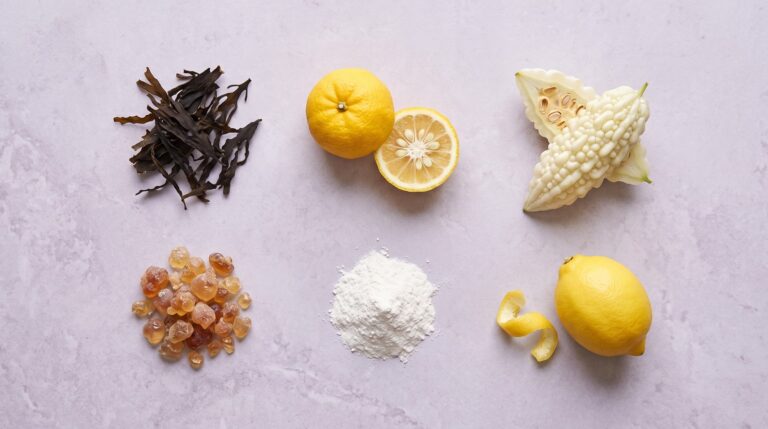
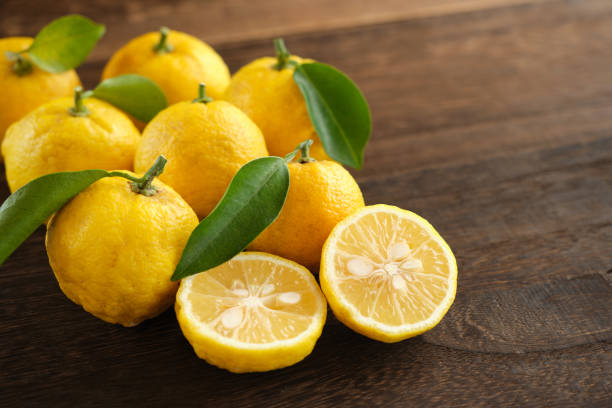
Yuzu is a Japanese citrus grown mainly for its aromatic peel, and yuzu extract is made from that peel rather than the juice. It is the ingredient that gives Kura Mynis its taste — and the one whose research is most often overstated, so here is what the published trial measured and what the size of that result actually means.
What this page is. A summary of published research on the ingredient yuzu extract. It is not a description of what Kura Mynis does. Kura Mynis is a food supplement, not a medicine, and is not intended to diagnose, treat, cure or prevent any disease.
01 — The fruit
What is yuzu?
Yuzu (Citrus junos Tanaka) is a yellow citrus fruit roughly the size of a mandarin, with a thick, intensely aromatic rind and comparatively little juice. It is believed to be a natural hybrid of mandarin and Ichang papeda, and it has been cultivated in East Asia for well over a thousand years.
In Japanese, Korean and Chinese cooking it is valued almost entirely for its peel and zest rather than its flesh — and the peel is also where the bioactive compounds studied by researchers are concentrated. That is a useful coincidence: the part of the fruit that carries the aroma is the part the extract is made from.
02 — Composition
What is in yuzu peel extract?
The ethanol extract of yuzu peel is rich in phenolic compounds, principally flavonoids. Five appear consistently in analyses:
| Compound | Class | Also found in |
|---|---|---|
| Hesperidin | Flavanone glycoside | Oranges, lemons |
| Naringin | Flavanone glycoside | Grapefruit, pomelo |
| Rutin | Flavonol glycoside | Buckwheat, citrus peel |
| Quercetin | Flavonol | Onions, apples, tea |
| Tangeretin | Polymethoxyflavone | Citrus peel |
These are dietary flavonoids, well characterised and widely present in ordinary fruit and vegetables.
All five are studied for antioxidant activity — the capacity to neutralise reactive molecules in laboratory conditions. Antioxidant activity measured in a test tube is a property of a compound, not a proven health outcome in a person, and the two should not be confused.
03 — The human data
What did the 8-week human trial find?
An 8-week placebo-controlled study in non-diabetic adults with impaired fasting glucose measured fasting plasma glucose (FPG) and related markers.
| Measure | Result |
|---|---|
| FPG at baseline (yuzu group) | 104.80 mg/dL |
| FPG after 8 weeks (yuzu group) | 104.31 mg/dL |
| Change within the yuzu group | −0.49 mg/dL (p = 0.729) |
| Yuzu vs. placebo comparison | p = 0.049 |
Conventional significance threshold is p < 0.05. Figures as reported in the published trial.
Two things are true at once here. The between-group comparison reached statistical significance, but only just — p = 0.049 sits fractionally under the 0.05 threshold. And the change itself was 0.49 mg/dL over eight weeks, from 104.80 to 104.31. A change that small is within the range of ordinary day-to-day variation in fasting glucose and is not a meaningful shift for an individual.
Statistical significance answers “is this difference probably real?” It does not answer “is this difference big enough to matter?” On this measure, the answer to the second question is no. Postprandial glucose measurements in the same study did not consistently reach significance either.
04 — In the formula
Why is yuzu in Kura Mynis?
Two honest reasons.
The first is taste. A daily supplement only works if you actually take it daily, and yuzu’s bright, floral citrus character is what makes Kura Mynis pleasant to drink — particularly alongside white bitter melon, which is named for exactly the quality you would expect.
The second is its flavonoid content, which places it among the better-characterised citrus extracts available. That is a reason to include it in a formula. It is not a claim that it will change your blood sugar.
05 — Cautions
Who should be careful with citrus extracts?
- Anyone taking prescribed medication. Some citrus flavonoids, naringin in particular, can affect how certain medicines are metabolised. Check with your doctor or pharmacist.
- Citrus allergy. Avoid if you react to citrus fruit or peel.
- Pregnant or breastfeeding. Kura Mynis is not formulated for use at these times.
- Managing a diagnosed condition. A supplement is not a substitute for medical care.
In the 8-week trial described above, fasting plasma glucose in the yuzu group moved from 104.80 to 104.31 mg/dL — a change of 0.49 mg/dL, which is too small to be meaningful for an individual even though the comparison with placebo reached p = 0.049. Yuzu should not be relied on to manage blood sugar.
Tart and highly aromatic — often described as somewhere between grapefruit, mandarin and lime, with a distinctive floral note. The flavour comes mainly from the peel, which is why yuzu is used as a zest and an extract rather than eaten as a fruit.
Principally hesperidin, naringin, rutin, quercetin and tangeretin. These are common dietary flavonoids also found in oranges, grapefruit, onions, apples and buckwheat, and all are studied for antioxidant activity.
No. Yuzu yields very little juice, and the compounds researchers study are concentrated in the peel. Yuzu extract is typically made from the peel, which is why its composition differs substantially from the juice.
Disclaimer. This article is for general information only and is not medical advice. Kura Mynis is a food supplement and is not intended to diagnose, treat, cure or prevent any disease. Individual results vary. Consult a qualified healthcare professional before starting any supplement, particularly if you are pregnant, breastfeeding, taking medication or managing a diagnosed condition.